Cityscape Farms, a greenhouse based urban farming initiative, promotes their mission with the slogan, “An idea whose time has come.” Whether it’s San Francisco’s new aggressive regional food policy or the famous organic garden on the White House lawn, the local food movement—specifically the urban local food movement—is garnering increasing media attention and validity. Yet, for Cityscape founder and CEO Mike Yohay, executing the launch of their pilot program has proven that where eco-entrepreneurship intersects with urban farming, there’s new ground to break.
Based in San Francisco, Cityscape Farms is a young company, currently in the initial stages of implementation. One could amend their slogan to read, “An idea in the making.” Yohay, a graduate of Dominican University’s Green MBA program, may be the next poster boy for the hipster meets locavore movement. Born in Brooklyn to a family of backyard farmers, his commitment to urban gardening evolved, paradoxically, when he left the city. When living in the Midwest, studying art and computer science, he observed industrial agriculture to be “massive and inefficient” and a stark contrast to the low-impact farming he participated in years later, in Costa Rica. There, he was impressed with the emphasis on recycling wastewater and its role in creating a self-sustaining food community.
The confluences of these experiences solidified Yohay’s vision. He has embraced, “the creative environment inherent in agriculture and horticulture,” and wants to seed cities with greenhouses, which he equates to “installations with a critical use.”
Yohay and his team have spent the last year researching every aspect of the Cityscape Farms project, from their target audience to the planned greenhouse design. They’re committed to hydroponic farming, a soil-less growing process in which minerals are dissolved in water where produce roots and then grows. For decades, hydroponics was the focus of the DIY crowd, though TV viewers may recognize hydroponic farming from Showtimes’s Weeds (season two). Increasingly, it’s celebrated not only for high crop yields, but also for its successful application in non-conventional settings.
In explaining hydroponics, Yohay grows animated: “At a time when 70% of the world’s fresh water is used for agriculture, more people should be paying attention to water. We need to care deeply about it – it’s a resource we are drastically mismanaging, one which we have a huge chance to reshape.”
Once Cityscape Farms has their pilot up and running, they face the challenge of advertising their produce in a market saturated with food labeling ambiguities. As our friends at TreeHugger remind us, hydroponic is not necessarily organic. Yohay asserts that their produce will be pesticide free, that in greenhouses, “By using fans and cross ventilation we can keep the air moving at such a pace that it is difficult for pests to settle on the plants.” Still, he recognizes that organic certification is, “the holy grail” for many consumers and is in conversation with certifiers in both California and Oregon.
The Cityscape model is similar to Gotham Greens and both aim to “close a loop in the food economy,” and highlight the insane amount of food imports (Did you know California imports as many strawberries as it exports?” Yohay asks).
What distinguishes Cityscape Farms, Yohay asserts, is their involvement in a community with “a specific ethos, slow food, sustainable food, and interaction between health and food,” The Cityscape team is vying for a role in San Francisco’s new policy and find it validating to see local government recognizing agriculture’s role in timely issues from the state of the economy to health care as they plan their launch.
The impact Cityscape Farms offers is still unknown but they identify with the food justice movement and want to embrace it with business acumen. As they scout lots, Yohay is pouring over maps of food distribution and access. He is focused on low-income neighborhoods and underutilized land, hoping to create green jobs as they grow.
http://www.triplepundit.com/2009/07/cityscape-farms-the-evolution-of-a-new-agricultural-model/
Showing posts with label public policy. Show all posts
Showing posts with label public policy. Show all posts
Saturday, August 1, 2009

Thursday, July 2, 2009
Exxon funding climate BS still ~
The world's largest oil company is continuing to fund lobby groups that question the reality of global warming, despite a public pledge to cut support for such climate change denial, a new analysis shows.
Company records show that ExxonMobil handed over hundreds of thousands of pounds to such lobby groups in 2008. These include the National Center for Policy Analysis (NCPA) in Dallas, Texas, which received $75,000 (£45,500), and the Heritage Foundation in Washington DC, which received $50,000.
According to Bob Ward, policy and communications director at the Grantham Research Institute on Climate Change and the Environment, at the London School of Economics, both the NCPA and the Heritage Foundation have published "misleading and inaccurate information about climate change."
On its website, the NCPA says: "NCPA scholars believe that while the causes and consequences of the earth's current warming trend is [sic] still unknown, the cost of actions to substantially reduce CO2 emissions would be quite high and result in economic decline, accelerated environmental destruction, and do little or nothing to prevent global warming regardless of its cause."
The Heritage Foundation published a "web memo" in December that said: "Growing scientific evidence casts doubt on whether global warming constitutes a threat, including the fact that 2008 is about to go into the books as a cooler year than 2007". Scientists, including those at the UK Met Office say that the apparent cooling is down to natural changes and does not alter the long-term warming trend.
In its 2008 corporate citizenship report, published last year, ExxonMobil said it would cut funds to several groups that "divert attention" from the need to find new sources of clean energy.
The NCPA and Heritage Foundation are included among groups funded by ExxonMobil, according to details of its "2008 Worldwide Contributions and Community Investments" published recently.
Ward said: "ExxonMobil has been briefing journalists for three years that they were going to stop funding these groups. The reality is that they are still doing it. If the world's largest oil company wants to fund climate change denial then it should be upfront about it, and not tell people it has stopped."
In 2006, Ward, then at the Royal Society, wrote to ExxonMobil to challenge the company's funding of such lobby groups. The move, revealed in the Guardian, prompted accusations of censorship and debate about whether experts should "police" the distribution of scientific information.
In an article on the Guardian website, Ward writes: "I have now written again to ExxonMobil to point out that these organisations publish misleading information about climate change on their websites, and to seek guidance on how to reconcile this fact with the pledge made by the company. I believe that the company should keep its promise by ending its financial support for lobby groups that mislead the public about climate change."
ExxonMobil said it annually reviews and adjusts its contributions to policy research groups. A spokesman said: "Only ExxonMobil speaks for ExxonMobil and our position on climate change is clear. We have the same concerns as people everywhere, and that is how to provide the world with the energy it needs while reducing greenhouse gas emissions. We take the issue of climate change seriously and the risks warrant action."
Company records show that ExxonMobil handed over hundreds of thousands of pounds to such lobby groups in 2008. These include the National Center for Policy Analysis (NCPA) in Dallas, Texas, which received $75,000 (£45,500), and the Heritage Foundation in Washington DC, which received $50,000.
According to Bob Ward, policy and communications director at the Grantham Research Institute on Climate Change and the Environment, at the London School of Economics, both the NCPA and the Heritage Foundation have published "misleading and inaccurate information about climate change."
On its website, the NCPA says: "NCPA scholars believe that while the causes and consequences of the earth's current warming trend is [sic] still unknown, the cost of actions to substantially reduce CO2 emissions would be quite high and result in economic decline, accelerated environmental destruction, and do little or nothing to prevent global warming regardless of its cause."
The Heritage Foundation published a "web memo" in December that said: "Growing scientific evidence casts doubt on whether global warming constitutes a threat, including the fact that 2008 is about to go into the books as a cooler year than 2007". Scientists, including those at the UK Met Office say that the apparent cooling is down to natural changes and does not alter the long-term warming trend.
In its 2008 corporate citizenship report, published last year, ExxonMobil said it would cut funds to several groups that "divert attention" from the need to find new sources of clean energy.
The NCPA and Heritage Foundation are included among groups funded by ExxonMobil, according to details of its "2008 Worldwide Contributions and Community Investments" published recently.
Ward said: "ExxonMobil has been briefing journalists for three years that they were going to stop funding these groups. The reality is that they are still doing it. If the world's largest oil company wants to fund climate change denial then it should be upfront about it, and not tell people it has stopped."
In 2006, Ward, then at the Royal Society, wrote to ExxonMobil to challenge the company's funding of such lobby groups. The move, revealed in the Guardian, prompted accusations of censorship and debate about whether experts should "police" the distribution of scientific information.
In an article on the Guardian website, Ward writes: "I have now written again to ExxonMobil to point out that these organisations publish misleading information about climate change on their websites, and to seek guidance on how to reconcile this fact with the pledge made by the company. I believe that the company should keep its promise by ending its financial support for lobby groups that mislead the public about climate change."
ExxonMobil said it annually reviews and adjusts its contributions to policy research groups. A spokesman said: "Only ExxonMobil speaks for ExxonMobil and our position on climate change is clear. We have the same concerns as people everywhere, and that is how to provide the world with the energy it needs while reducing greenhouse gas emissions. We take the issue of climate change seriously and the risks warrant action."
Wednesday, June 10, 2009
News Ltd HQ of the "lies about climate and carbon" biz
The resource industry's spin on global warming is pervasive. Through lobby groups - the Minerals Council, the Australian Petroleum Production and Exploration Association (APPEA) and the cleverly titled Australian Industry Greenhouse Network, which hopes to accelerate the greenhouse effect - the likes of Rio Tinto and BHP Billiton stop real action on climate change.
Former Liberal staffer-turned-author and Greens candidate Guy Pearse has shown how the self-titled "greenhouse mafia" - the carbon lobby - has dominated climate change policy under prime ministers from Bob Hawke to Kevin Rudd (and especially John Howard).
Less well documented so far has been the industry's influence on the media. Take the powerful News Corporation, which publishes two-thirds of our remaining newspapers. Despite a spectacular about-face on climate change in 2007 by News Corp's chairman Rupert Murdoch, no media group can match the Murdoch press for consistently fomenting global warming scepticism and arguing against climate change mitigation measures.
News Corp's tabloid provocateurs Piers Akerman and Andrew Bolt rail against greenies every other day but don't have the attention to detail to influence national debate on climate change science, emissions trading and reduction targets, and international negotiations on global warming.
The Australian - Rupert's baby and local flagship - does. But nothing you read on climate change in The Australian can be taken at face value. Its coverage of the issue is effectively sponsored by the resources industry.
Confirmation came this week when The Australian had the gall to trumpet a media award given by the oil and gas lobby group, APPEA, to editor-in-chief Chris Mitchell: "… the JN Pierce Award for Media Excellence for leading the newspaper's coverage of climate change policy. For the first time, the judging panel presented the award to an editor rather than a reporter or columnist. APPEA chief executive Belinda Robinson said that over the past 12 months The Australian's 'in-depth coverage of a range of public policy issues affecting Australia's upstream oil and gas industry has been of a consistently high standard'."
Gobsmacking. A disgraceful admission.
Bob Burton, author of the book Inside Spin and editor of Sourcewatch, which tracks the PR industry, says industry media awards are proliferating and are used to identify potentially sympathetic journalists, improve access and shape their coverage. It is unnecessary in this case - News Corp has been trashing the climate change debate forever.
Murdoch, always fervently pro-business, has supported right-wing think tanks such as the Institute of Public Affairs (by donating and at one stage joining its advisory council) and the Cato Institute in the United States.
University of NSW associate professor David McKnight has studied News Corp's climate change coverage and has an essay coming out on the topic. Until 2007, he says, Murdoch papers scorned the idea that burning fossil fuels could affect the climate.
"Climate science was seen as a form of political correctness," McKnight says. "Many people have said if you want to know what Rupert Murdoch really thinks, read the editorial and [opinion] pages of the New York Post. If you do that on climate, you find a virulent platform for climate deniers. There were quite vicious attacks on Al Gore, for example. It gave a platform to Exxon-funded climate sceptics. It supported [former president George] Bush's rejection of Kyoto several times in editorials."
Then on May 9, 2007, apparently at the urging of son James, Murdoch announced News Corp would go carbon neutral by 2010.
In a speech to worldwide staff, Murdoch said the planet should be given "the benefit of the doubt".
He went further. News Corp, he said, "can do something that's unique, different from just [about] any other company. We can set an example, and we can reach our audiences. Our audience's carbon footprint is 10,000 times bigger than ours. That's the carbon footprint we want to conquer.
"We want to inspire people to change their behaviour … for too long, the threats of climate change have been presented as doom and gloom - because the consequences are so serious. We need to do what our company does best: make this issue exciting. Tell the story in a new way."
This put The Australian in a quandary. Mitchell's then 2IC, Michael Stutchbury, was still freely describing climate change as "bullshit" and joked after the announcement, "What would the Murdochs know?" (He is now the paper's economics editor.)
What did The Australian do? In late 2006 Matthew Warren, former PR for the NSW Minerals Council, was appointed - get this - environment reporter. His standard line was how difficult, how expensive, measures to combat global warming would be. He practically never quoted the environment movement or its representatives. (He now runs business group the Clean Energy Council, which is meant to promote renewable energy but has been taken over by the carbon lobby.)
The Australian had long published advertising-driven special reports on the "oil and gas" and "coal" industries. Regular writers included former APPEA executive director Keith Orchison.
In 2008 these were rebranded the "Business & Environment Series". Same writers, same pro-industry stance. (Lately it's the "Climate Series".)
But a leopard can't change its spots. An October 2007 leader worried that a victorious Rudd would "withdraw Australia from the ANZUS alliance, shut down the coalmines, declare Australia a republic, make gay marriage compulsory and transform the nation into a wind-powered, mung-bean-eating Arcadia".
Once the emissions trading debate got serious, The Australian reverted to type. Last year a global group of scientists working on climate issues, publishing at RealClimate.org, gave The Australian their "most consistently wrong media outlet" award.
The back-scratching happens routinely. The Australian was journal of choice for a leak from the Minerals Council, which led to a front-page story on May 22 on the alarming number of jobs that might be lost if the proposed carbon pollution reduction scheme was introduced. Zero scepticism in that story.
Another example: last month, the paper went big on the front page on a story about how recent research showed Antarctic ice was growing, not shrinking. They were forced to back-pedal embarrassingly a fortnight later. Bureau of Meteorology scientist Andrew Watkins accused the reporter of misrepresenting the results of a study by the British Antarctic Survey.
"You kept going until you got the answer you wanted," Dr Watkins told the paper's reporter, in a story published on page 7.
Far from reporting without fear or favour, The Australian is waging a war on climate change. And it is winning.
McKnight says Murdoch's landmark 2007 speech "almost daily … is being effectively contradicted by the coverage of climate that The Australian publishes … [Today it is] the only News Corp publication which still consistently promotes climate scepticism."
Mitchell is a powerful individual. Before the 2007 election, no pollie made the lonely trek across the newsroom to Mitchell's office as often as Kevin Rudd.
Last year a former editor of this newspaper and publisher of Crikey.com.au, Eric Beecher, was lauding Rupert Murdoch's News Ltd as the "future of newspapers" here and saying The Australian was our "sole remaining commercially owned source of serious journalism".
Earlier this year, Beecher wrote: "Despite The Australian's often strident right-leaning editorial and ownership bias … it does not publish political commentary and analysis viewed exclusively through a single lens."
Well, that's not true on climate change. And the joke is on the rest of us.
Former Liberal staffer-turned-author and Greens candidate Guy Pearse has shown how the self-titled "greenhouse mafia" - the carbon lobby - has dominated climate change policy under prime ministers from Bob Hawke to Kevin Rudd (and especially John Howard).
Less well documented so far has been the industry's influence on the media. Take the powerful News Corporation, which publishes two-thirds of our remaining newspapers. Despite a spectacular about-face on climate change in 2007 by News Corp's chairman Rupert Murdoch, no media group can match the Murdoch press for consistently fomenting global warming scepticism and arguing against climate change mitigation measures.
News Corp's tabloid provocateurs Piers Akerman and Andrew Bolt rail against greenies every other day but don't have the attention to detail to influence national debate on climate change science, emissions trading and reduction targets, and international negotiations on global warming.
The Australian - Rupert's baby and local flagship - does. But nothing you read on climate change in The Australian can be taken at face value. Its coverage of the issue is effectively sponsored by the resources industry.
Confirmation came this week when The Australian had the gall to trumpet a media award given by the oil and gas lobby group, APPEA, to editor-in-chief Chris Mitchell: "… the JN Pierce Award for Media Excellence for leading the newspaper's coverage of climate change policy. For the first time, the judging panel presented the award to an editor rather than a reporter or columnist. APPEA chief executive Belinda Robinson said that over the past 12 months The Australian's 'in-depth coverage of a range of public policy issues affecting Australia's upstream oil and gas industry has been of a consistently high standard'."
Gobsmacking. A disgraceful admission.
Bob Burton, author of the book Inside Spin and editor of Sourcewatch, which tracks the PR industry, says industry media awards are proliferating and are used to identify potentially sympathetic journalists, improve access and shape their coverage. It is unnecessary in this case - News Corp has been trashing the climate change debate forever.
Murdoch, always fervently pro-business, has supported right-wing think tanks such as the Institute of Public Affairs (by donating and at one stage joining its advisory council) and the Cato Institute in the United States.
University of NSW associate professor David McKnight has studied News Corp's climate change coverage and has an essay coming out on the topic. Until 2007, he says, Murdoch papers scorned the idea that burning fossil fuels could affect the climate.
"Climate science was seen as a form of political correctness," McKnight says. "Many people have said if you want to know what Rupert Murdoch really thinks, read the editorial and [opinion] pages of the New York Post. If you do that on climate, you find a virulent platform for climate deniers. There were quite vicious attacks on Al Gore, for example. It gave a platform to Exxon-funded climate sceptics. It supported [former president George] Bush's rejection of Kyoto several times in editorials."
Then on May 9, 2007, apparently at the urging of son James, Murdoch announced News Corp would go carbon neutral by 2010.
In a speech to worldwide staff, Murdoch said the planet should be given "the benefit of the doubt".
He went further. News Corp, he said, "can do something that's unique, different from just [about] any other company. We can set an example, and we can reach our audiences. Our audience's carbon footprint is 10,000 times bigger than ours. That's the carbon footprint we want to conquer.
"We want to inspire people to change their behaviour … for too long, the threats of climate change have been presented as doom and gloom - because the consequences are so serious. We need to do what our company does best: make this issue exciting. Tell the story in a new way."
This put The Australian in a quandary. Mitchell's then 2IC, Michael Stutchbury, was still freely describing climate change as "bullshit" and joked after the announcement, "What would the Murdochs know?" (He is now the paper's economics editor.)
What did The Australian do? In late 2006 Matthew Warren, former PR for the NSW Minerals Council, was appointed - get this - environment reporter. His standard line was how difficult, how expensive, measures to combat global warming would be. He practically never quoted the environment movement or its representatives. (He now runs business group the Clean Energy Council, which is meant to promote renewable energy but has been taken over by the carbon lobby.)
The Australian had long published advertising-driven special reports on the "oil and gas" and "coal" industries. Regular writers included former APPEA executive director Keith Orchison.
In 2008 these were rebranded the "Business & Environment Series". Same writers, same pro-industry stance. (Lately it's the "Climate Series".)
But a leopard can't change its spots. An October 2007 leader worried that a victorious Rudd would "withdraw Australia from the ANZUS alliance, shut down the coalmines, declare Australia a republic, make gay marriage compulsory and transform the nation into a wind-powered, mung-bean-eating Arcadia".
Once the emissions trading debate got serious, The Australian reverted to type. Last year a global group of scientists working on climate issues, publishing at RealClimate.org, gave The Australian their "most consistently wrong media outlet" award.
The back-scratching happens routinely. The Australian was journal of choice for a leak from the Minerals Council, which led to a front-page story on May 22 on the alarming number of jobs that might be lost if the proposed carbon pollution reduction scheme was introduced. Zero scepticism in that story.
Another example: last month, the paper went big on the front page on a story about how recent research showed Antarctic ice was growing, not shrinking. They were forced to back-pedal embarrassingly a fortnight later. Bureau of Meteorology scientist Andrew Watkins accused the reporter of misrepresenting the results of a study by the British Antarctic Survey.
"You kept going until you got the answer you wanted," Dr Watkins told the paper's reporter, in a story published on page 7.
Far from reporting without fear or favour, The Australian is waging a war on climate change. And it is winning.
McKnight says Murdoch's landmark 2007 speech "almost daily … is being effectively contradicted by the coverage of climate that The Australian publishes … [Today it is] the only News Corp publication which still consistently promotes climate scepticism."
Mitchell is a powerful individual. Before the 2007 election, no pollie made the lonely trek across the newsroom to Mitchell's office as often as Kevin Rudd.
Last year a former editor of this newspaper and publisher of Crikey.com.au, Eric Beecher, was lauding Rupert Murdoch's News Ltd as the "future of newspapers" here and saying The Australian was our "sole remaining commercially owned source of serious journalism".
Earlier this year, Beecher wrote: "Despite The Australian's often strident right-leaning editorial and ownership bias … it does not publish political commentary and analysis viewed exclusively through a single lens."
Well, that's not true on climate change. And the joke is on the rest of us.
Saturday, March 28, 2009
Ozone disaster averted
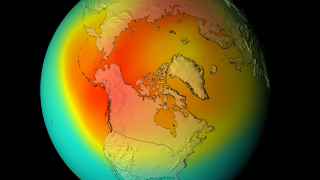
Led by NASA Goddard scientist Paul Newman, a team of atmospheric chemists simulated 'what might have been' if chlorofluorocarbons (CFCs) and similar ozone-depleting chemicals were not banned through the Montreal Protocol. The comprehensive model -- including atmospheric chemical effects, wind changes, and solar radiation changes -- simulated what would happen to global concentrations of stratospheric ozone if CFCs were continually added to the atmosphere.
The visualizations below present two cases, from several different viewing positions: the 'world avoided' case, where the rate of CFC emission into the atmosphere is assumed to be that of the period before regulation, and the 'projected' case, which assumes the current rate of emission, post-regulation. Both cases extrapolate to the year 2065.
link
Subscribe to:
Posts (Atom)
