BOULDER—Spurred by a warming climate, daily record high temperatures occurred twice as often as record lows over the last decade across the continental United States, new research shows. The ratio of record highs to lows is likely to increase dramatically in coming decades if emissions of greenhouse gases continue to climb.
"Climate change is making itself felt in terms of day-to-day weather in the United States," says Gerald Meehl, the lead author and a senior scientist at the National Center for Atmospheric Research (NCAR). "The ways these records are being broken show how our climate is already shifting."
http://www.ucar.edu/news/releases/2009/maxmin.jsp
Showing posts with label global warming. Show all posts
Showing posts with label global warming. Show all posts
Saturday, November 21, 2009

Sunday, October 4, 2009
Such lies......
The man behind the latest entry to the climate legislation wars is H. Leighton Steward, a veteran oil industry executive, co-author of the “Sugar Busters!” dieting books, and winner of an Environmental Protection Agency award for a report on damage being done to Mississippi wetlands. Now retired, he says he wants to “get the message out there” that carbon dioxide, which the Supreme Court has ruled a pollutant and which most scientists regard as a dangerous greenhouse gas, “is a net benefit for the planet.”
Well, thank the Great Flying Spaghetti Monster that we have oil company bigwigs to steer us in the right direction, not only with these super-intelligent and truthful ads, but by pumping as much CO2 into the atmosphere as humanly possible.
Monday, September 7, 2009
Solar Hot Water big in China
latimes.com/news/nationworld/nation/la-fi-china-solar6-2009sep06,0,7213756.story
latimes.com
China, green? In the case of solar water heating, yes
In a nation known more for its belching smokestacks, solar water heaters are on nearly every roof in some cities. Manufacturers are eyeing foreign markets, including Southern California.
By David Pierson
September 6, 2009
Reporting from Rizhao, China
Before her family bought a solar water heater, Liu Yan would bathe the way many working-class Chinese have for generations: boil water, dampen a rag and wipe away the dirt.
Today, the 40-year-old mother and her family shower every day and wash their dishes with hot water. The stainless steel heater affixed to her red-tiled roof cost about $220.
The device has become a symbol of China's rising standard of living and its leap into the era of clean energy.
In the seaside city of 2.8 million where Liu lives in Shandong province, 99% of households use solar water heaters. The mattress-sized contraptions dominate Rizhao's skyline, resting haphazardly on almost every residential rooftop.
In the global race to develop green technology and stem climate change, China has quickly become a leading producer of solar panels and wind turbines. It also dominates the lesser-known technology of solar water heaters.
Using principles of solar heating more than a century old, the humble, low-cost devices consist of an angled row of cola-colored glass tubes that absorb heat from the sun. The most common models fill the tubes with cold water. As it heats, the water rises into an insulated tank where it can remain hot for days.
The devices have improved so much over the years that some don't need direct sunlight -- all the more valuable in China's often hazy and smoggy cities. Newer models have electrical heaters inside the water tanks that switch on if the water gets too cold on frigid days.
Popular in some parts of the United States around the turn of the 20th century before being made obsolete by cheap natural gas, solar heaters are now hailed as one of China's greatest environmental success stories. More than 30 million homes have the devices, accounting for two-thirds of the world's solar water heating energy.
Manufacturers are eyeing foreign markets, including customers in Southern California.
"China absolutely dominates the global market and they've done it relatively quietly and without a lot of fanfare," said Christopher Flavin, president of the Washington-based Worldwatch Institute. "It's an interesting example of their ability to take technology that was developed elsewhere and adapt it to their market on a scale no one had conceived of."
The widespread development of solar heaters in China can appear paradoxical in a country that leads the world in carbon dioxide emissions and where two-thirds of the rivers and lakes are contaminated.
Such is the nature of China's push to tackle climate change. In this rapidly developing economy, some of the nation's biggest polluters reside alongside the biggest renewable energy projects.
Scenes like Rizhao's crowded, energy-efficient rooftops are repeated all over China, often in the shadows of carbon spewing smokestacks and noxious chemical plants. Rizhao is one of a small but growing number of Chinese cities requiring solar heaters to be installed or subsidized.
"There are two different stories in China," said Barbara Finamore, director of the National Resources Defense Council's China Program. "There's dramatic progress. There's no denying that. At the same time, they're still building, on average, a new coal-fired plant every week."
The heating of water accounts for a quarter of a typical building's energy usage. The Chinese solar heaters are estimated to have prevented more than 20 million tons of carbon dioxide that would have been emitted annually using electrical units.
The heaters will be much needed if Beijing is to meet its goal of reducing its reliance on coal, which supplies 80% of the country's energy. The central government aims to meet 15% of its energy needs through renewable sources by 2020. Beijing hopes to triple its solar heater capacity by the same year, according to Greenpeace China.
The technology's gains here lie in its affordability, the dearth of residential natural gas service and the modest expectations of consumers, many of whom had never enjoyed hot water at home before. The starting price for one of the clunky devices is around $220, about the same as an electric heater in China. In the United States, where labor costs are higher and systems tend to be larger and more elaborate, solar water heaters can easily cost $1,500 or more.
"The key to the success in China is that the low price enables people to have an instantaneous payback," said John Perlin, a solar energy historian and author of "From Space to Earth: The Story of Solar Electricity."
A thriving, hyper-competitive industry of 5,000 manufacturers has grown up in the last decade or more, driving costs down and widening the range of quality.
"The market is huge, but the competition is fearsome," said Bi Bangquan, president of Ri- zhao Gold Giant Solar Power, one of 150 manufacturers based in the city.
To find new customers, he's turned to rural areas. That can mean sending sales teams to villages, where stages are erected for singing and dancing performers to promote the virtues of his solar heaters.
Each manufacturer touts its product's ability to heat water within hours and insulate that heat for days.
"I guarantee my water's hot enough to take the feathers off a chicken," said one of Bi's rivals, Zhang Shouqin, founder of Rizhao Qin Naier Solar Power.
Some Chinese companies hoping to boost sales are looking to other countries, including the United States. Only about 1% of the world's solar water heating energy is produced in the U.S., but climate change is spurring interest in the technology. The California Public Utilities Commission has recommended the establishment of a $300-million incentive program to encourage homeowners to install units.
Bi dreams of exporting, but he's concerned that his heaters would be no match for Western habits. A typical American uses 100 gallons of water daily, both hot and cold, according to the U.S. Environmental Protection Agency. In China, an urban resident uses half that, and a rural dweller about a fifth.
Many of the older or cheaper Chinese models are far from perfect, lacking auxiliary heating elements to warm the water on cloudy days.
"I have to look outside and make sure it's been sunny before I decide to take a shower," said a 53-year-old retiree in Rizhao who gave only his surname, Xiao. "Otherwise you'll get a cold surprise."
About 225 miles northwest of Rizhao is the headquarters of Himin Solar Energy Group, China's largest and most advanced solar water heater maker, which recently garnered a $50-million investment from Goldman Sachs.
Himin's influence runs deep in its hometown, Dezhou. The streets of the city of 5.5 million are illuminated with solar-powered lights; 90% of its households have solar water heaters.
Company founder Huang Ming is building an expansive residential development in Dezhou called Utopia Garden to showcase the potential of solar technology. Scheduled for completion in 2013, the row of high-rise buildings will be crowned with a ribbon of solar thermal tubing and photovoltaic panels that will supply much of the complex's energy needs.
"We're only at the bottom of a big mountain," Huang said. Solar "can push a change in lifestyle."
david.pierson@latimes.com
Nicole Liu in The Times' Beijing Bureau contributed to this report.
Copyright © 2009, The Los Angeles Times
latimes.com
China, green? In the case of solar water heating, yes
In a nation known more for its belching smokestacks, solar water heaters are on nearly every roof in some cities. Manufacturers are eyeing foreign markets, including Southern California.
By David Pierson
September 6, 2009
Reporting from Rizhao, China
Before her family bought a solar water heater, Liu Yan would bathe the way many working-class Chinese have for generations: boil water, dampen a rag and wipe away the dirt.
Today, the 40-year-old mother and her family shower every day and wash their dishes with hot water. The stainless steel heater affixed to her red-tiled roof cost about $220.
The device has become a symbol of China's rising standard of living and its leap into the era of clean energy.
In the seaside city of 2.8 million where Liu lives in Shandong province, 99% of households use solar water heaters. The mattress-sized contraptions dominate Rizhao's skyline, resting haphazardly on almost every residential rooftop.
In the global race to develop green technology and stem climate change, China has quickly become a leading producer of solar panels and wind turbines. It also dominates the lesser-known technology of solar water heaters.
Using principles of solar heating more than a century old, the humble, low-cost devices consist of an angled row of cola-colored glass tubes that absorb heat from the sun. The most common models fill the tubes with cold water. As it heats, the water rises into an insulated tank where it can remain hot for days.
The devices have improved so much over the years that some don't need direct sunlight -- all the more valuable in China's often hazy and smoggy cities. Newer models have electrical heaters inside the water tanks that switch on if the water gets too cold on frigid days.
Popular in some parts of the United States around the turn of the 20th century before being made obsolete by cheap natural gas, solar heaters are now hailed as one of China's greatest environmental success stories. More than 30 million homes have the devices, accounting for two-thirds of the world's solar water heating energy.
Manufacturers are eyeing foreign markets, including customers in Southern California.
"China absolutely dominates the global market and they've done it relatively quietly and without a lot of fanfare," said Christopher Flavin, president of the Washington-based Worldwatch Institute. "It's an interesting example of their ability to take technology that was developed elsewhere and adapt it to their market on a scale no one had conceived of."
The widespread development of solar heaters in China can appear paradoxical in a country that leads the world in carbon dioxide emissions and where two-thirds of the rivers and lakes are contaminated.
Such is the nature of China's push to tackle climate change. In this rapidly developing economy, some of the nation's biggest polluters reside alongside the biggest renewable energy projects.
Scenes like Rizhao's crowded, energy-efficient rooftops are repeated all over China, often in the shadows of carbon spewing smokestacks and noxious chemical plants. Rizhao is one of a small but growing number of Chinese cities requiring solar heaters to be installed or subsidized.
"There are two different stories in China," said Barbara Finamore, director of the National Resources Defense Council's China Program. "There's dramatic progress. There's no denying that. At the same time, they're still building, on average, a new coal-fired plant every week."
The heating of water accounts for a quarter of a typical building's energy usage. The Chinese solar heaters are estimated to have prevented more than 20 million tons of carbon dioxide that would have been emitted annually using electrical units.
The heaters will be much needed if Beijing is to meet its goal of reducing its reliance on coal, which supplies 80% of the country's energy. The central government aims to meet 15% of its energy needs through renewable sources by 2020. Beijing hopes to triple its solar heater capacity by the same year, according to Greenpeace China.
The technology's gains here lie in its affordability, the dearth of residential natural gas service and the modest expectations of consumers, many of whom had never enjoyed hot water at home before. The starting price for one of the clunky devices is around $220, about the same as an electric heater in China. In the United States, where labor costs are higher and systems tend to be larger and more elaborate, solar water heaters can easily cost $1,500 or more.
"The key to the success in China is that the low price enables people to have an instantaneous payback," said John Perlin, a solar energy historian and author of "From Space to Earth: The Story of Solar Electricity."
A thriving, hyper-competitive industry of 5,000 manufacturers has grown up in the last decade or more, driving costs down and widening the range of quality.
"The market is huge, but the competition is fearsome," said Bi Bangquan, president of Ri- zhao Gold Giant Solar Power, one of 150 manufacturers based in the city.
To find new customers, he's turned to rural areas. That can mean sending sales teams to villages, where stages are erected for singing and dancing performers to promote the virtues of his solar heaters.
Each manufacturer touts its product's ability to heat water within hours and insulate that heat for days.
"I guarantee my water's hot enough to take the feathers off a chicken," said one of Bi's rivals, Zhang Shouqin, founder of Rizhao Qin Naier Solar Power.
Some Chinese companies hoping to boost sales are looking to other countries, including the United States. Only about 1% of the world's solar water heating energy is produced in the U.S., but climate change is spurring interest in the technology. The California Public Utilities Commission has recommended the establishment of a $300-million incentive program to encourage homeowners to install units.
Bi dreams of exporting, but he's concerned that his heaters would be no match for Western habits. A typical American uses 100 gallons of water daily, both hot and cold, according to the U.S. Environmental Protection Agency. In China, an urban resident uses half that, and a rural dweller about a fifth.
Many of the older or cheaper Chinese models are far from perfect, lacking auxiliary heating elements to warm the water on cloudy days.
"I have to look outside and make sure it's been sunny before I decide to take a shower," said a 53-year-old retiree in Rizhao who gave only his surname, Xiao. "Otherwise you'll get a cold surprise."
About 225 miles northwest of Rizhao is the headquarters of Himin Solar Energy Group, China's largest and most advanced solar water heater maker, which recently garnered a $50-million investment from Goldman Sachs.
Himin's influence runs deep in its hometown, Dezhou. The streets of the city of 5.5 million are illuminated with solar-powered lights; 90% of its households have solar water heaters.
Company founder Huang Ming is building an expansive residential development in Dezhou called Utopia Garden to showcase the potential of solar technology. Scheduled for completion in 2013, the row of high-rise buildings will be crowned with a ribbon of solar thermal tubing and photovoltaic panels that will supply much of the complex's energy needs.
"We're only at the bottom of a big mountain," Huang said. Solar "can push a change in lifestyle."
david.pierson@latimes.com
Nicole Liu in The Times' Beijing Bureau contributed to this report.
Copyright © 2009, The Los Angeles Times
Sunday, September 6, 2009
Artic warmer than for 2000 years...
The Arctic is now warmer than at any time during the last 2,000 years, according to a major new study.
Temperatures around the North Pole have dramatically increased in the last 50 years - reversing a long-term natural cooling trend, scientists say.
The study, based on an analysis of ice cores, lake sediments and tree rings, provides compelling evidence that greenhouse gases released since the start of the industrial revolution are triggering global warming, the researchers say.
Researchers secure a floating platform in Alaska to take sediment cores. They reported finding yet more proof that global warming was a dangerous reality
Lead author Darrell Kaufman of Northern Arizona University said: 'Scientists have known for a while that the current period of warming was preceded by a long-term cooling trend. But our reconstruction quantifies the cooling with greater certainty than before.'
The research - published in the journal Science - comes from a team of British and American geologists who tracked summer Arctic temperatures to the time of the Romans by studying natural signals in the landscape.
Their reconstruction found that the Arctic got cooler in the summer months between 1AD and 1900, thanks to a natural 'wobble' in the Earth's orbit around the Sun.
The wobble slowly increased the distance between the Earth and the Sun during the Arctic summer, reducing summer temperatures by around 0.2C every thousand years and causing the 'Little Ice Age' that led to freezing winters in the 17th, 18th and 19th centuries.
But during the 20th century, temperatures began to rise dramatically - even though the amount of sunlight reaching the Arctic during the summer was continuing to fall.
The decade between 1999 to 2008 was the warmest in the last 2,000 years, the research found.
The researchers say the Arctic should still be cooling because the Earth is now about 600,000 miles farther away from the Sun than it was in 1BC.
They estimate that by the middle of the century, summer Arctic temperatures were about 0.7C higher than would have been expected if the cooling trend had continued.
Today, temperatures are around 1.4C higher than they should be, the authors say.
Dr David Schneider, from the National Centre for Atmospheric Research in Colorado, said: 'This result is particularly important because the Arctic, perhaps more than any other region on Earth, is facing dramatic impacts from climate change.
'This study provides us with a long-term record that reveals how greenhouse gases from human activities are overwhelming the Arctic's natural climate system.
'Greenhouse gases are overtaking a natural cycle.'
The temperature reconstruction looked at the amount of algae in sediments in Arctic lakes - which reflect the length of the growing season - and the thickness of annually deposited layers of sediment which increase during warmer summers when deposits from glacial melt water increases.
They also looked at records of tree rings. The amount of new growth of a tree each year is strongly linked to the temperature of the growing season.
The Arctic appears to be particularly vulnerable to changes to the Earth's climate.
Previous research has shown that Arctic temperatures rose three times faster during the 20th century than the rest of the Northern Hemisphere.
Some experts have predicted that the Arctic could be free from sea ice in the winter within the next few decades if the temperatures continue to rise
Temperatures around the North Pole have dramatically increased in the last 50 years - reversing a long-term natural cooling trend, scientists say.
The study, based on an analysis of ice cores, lake sediments and tree rings, provides compelling evidence that greenhouse gases released since the start of the industrial revolution are triggering global warming, the researchers say.
Researchers secure a floating platform in Alaska to take sediment cores. They reported finding yet more proof that global warming was a dangerous reality
Lead author Darrell Kaufman of Northern Arizona University said: 'Scientists have known for a while that the current period of warming was preceded by a long-term cooling trend. But our reconstruction quantifies the cooling with greater certainty than before.'
The research - published in the journal Science - comes from a team of British and American geologists who tracked summer Arctic temperatures to the time of the Romans by studying natural signals in the landscape.
Their reconstruction found that the Arctic got cooler in the summer months between 1AD and 1900, thanks to a natural 'wobble' in the Earth's orbit around the Sun.
The wobble slowly increased the distance between the Earth and the Sun during the Arctic summer, reducing summer temperatures by around 0.2C every thousand years and causing the 'Little Ice Age' that led to freezing winters in the 17th, 18th and 19th centuries.
But during the 20th century, temperatures began to rise dramatically - even though the amount of sunlight reaching the Arctic during the summer was continuing to fall.
The decade between 1999 to 2008 was the warmest in the last 2,000 years, the research found.
The researchers say the Arctic should still be cooling because the Earth is now about 600,000 miles farther away from the Sun than it was in 1BC.
They estimate that by the middle of the century, summer Arctic temperatures were about 0.7C higher than would have been expected if the cooling trend had continued.
Today, temperatures are around 1.4C higher than they should be, the authors say.
Dr David Schneider, from the National Centre for Atmospheric Research in Colorado, said: 'This result is particularly important because the Arctic, perhaps more than any other region on Earth, is facing dramatic impacts from climate change.
'This study provides us with a long-term record that reveals how greenhouse gases from human activities are overwhelming the Arctic's natural climate system.
'Greenhouse gases are overtaking a natural cycle.'
The temperature reconstruction looked at the amount of algae in sediments in Arctic lakes - which reflect the length of the growing season - and the thickness of annually deposited layers of sediment which increase during warmer summers when deposits from glacial melt water increases.
They also looked at records of tree rings. The amount of new growth of a tree each year is strongly linked to the temperature of the growing season.
The Arctic appears to be particularly vulnerable to changes to the Earth's climate.
Previous research has shown that Arctic temperatures rose three times faster during the 20th century than the rest of the Northern Hemisphere.
Some experts have predicted that the Arctic could be free from sea ice in the winter within the next few decades if the temperatures continue to rise
Monday, August 31, 2009
On the post carbon die-off; a rebuttal....
We don't innovate with energy because it is too cheap...but we will all be innovating big time sooner or later......not starving in the dark.
“Leibig’s Law” states that growth in a system is controlled not by the total of resources available, but by the scarcest resource (limiting factor). How does this apply energy production? I have about 7.20E+03 pounds of lead in my home PV system. Global production of lead is about 3.88E+06 tonnes per year. The 1.30E+08 homes in the US would require 9.36E+11 pounds (4.25E+08 tonnes) of lead every eight or so years. For alternate energy storage in homes, the US alone would need 100 times the current global production of lead – six times the global reserves of lead – just for US home electrical storage (that number DOES NOT include transportation or business)! Therefore, we know that it’s literally impossible for alternative energy to replace fossil fuels. It’s literally true that “peak oil” is equivalent to “peak everything.” More on scarce minerals at http://www.theoildrum.com/node/5559 http://europe.theoildrum.com/node/5239
I send your post to my engineering friend, Here are his comments:
This guy is living the standard brainless clueless USA energy hog existence with 7000 lb. worth of batteries. In contrast Barbara Kerr (Kerr-Cole Sustainable Living Center) gets by on 480 lb. and I live happily with 240 lb. of batteries. Nonetheless he has the right idea regarding lead. According to globalleadnet.com STRONG>/ STRONG> /FONT> STRONG>/ STRONG> /file_download/17/5.pdf the US production was from 477,000 metric tonnes of 65% ore concentrate, which works out to 680,000,000 lb. in primary lead (not from recycling) sources (mining) in 1991. This is enough to supply 1000 lb of batteries to 680,000 new installations. Presumably existing installations will recycle lead, and therefore will neither add nor subtract from the lead supply. This guy forgot that lead is not consumed in batteries in 8 years; it is nearly 100% recyclable. He forgets that there are other battery technologies that will come into the mix: nickel-metal-hydride (my Prius for example) and lithium ion (the coming plug-in Prius for example). The future probably lies in running your house partially off the car battery using grid-tie EV technology - and learning to live with severe electrical energy rationing (by today's standards). This guy is also ignorant of compressed air automotive technology. And of power grid storage options such as hydrogen, ammonia (a much more practical offshoot of hydrogen), compressed air, flywheels and pumped hydro for on-demand electricity production. Not everybody needs batteries in a renewable, alternative technology. One can use the grid via net metering to store what one generates, or just buy the alternative juice from the utility.
Most important, he is neglecting geothermal energy which is a base load technology (runs 24/7 and therefore does not require any storage whatsoever). I am right now at one of the most advanced geothermal plants in the world, Chena Hot Springs near Fairbanks. The maverick entrepreneur owner of this spa put in a cutting edge power plant a three years ago on his own nickel (well 2.5 megabucks, actually) for 1/5 the cost of conventional technology, mainly by modifying a standard industrial chiller to operate in reverse using mostly off-the shelf components (with concomitant economies of scale using reliable mature design equipment that has been in production for decades). He has cut his electrical energy cost by $500,000 dollars a year because he has replaced diesel ($0.50 per kWh operating cost) with geo ($0.02 per kWh operating cost). The key innovation is that it runs off low relatively low temperature hot water, making it operable from deep earth heated water from depleted oil wells. This the "geothermal anywhere" (GA) concept. He is now going into the business of putting 200 kW mobile power plants on a semi trailers and leasing them out to wherever waste heat or easy geothermal is available. The first two mobile units are supplying power to this community and my computer right now as they undergo pre-delivery testing (they are temporarily replacing the on-site power plant). Very soon they will take a 6000 mile trip to Florida to run on oil well waste heat.
The installed plant here produces twice the power the community needs (for emergency backup redundancy for service down-time or failure of one of the generators). So he just put in a hydrogen electrolysis plant to transport "stranded" excess energy capacity to market. Waste heat warms four-season greenhouses (the tomato plants are 14 months old and producing like gangbusters). He has all the lighting he wants to keep the grow lights on in the winter 24/7, 100 miles from the arctic circle. He plans to become self-sufficient in food.
Interesting, huh? You might think about relocating to a community with hot spring or depleted oil well. There may be a future in it.
“Leibig’s Law” states that growth in a system is controlled not by the total of resources available, but by the scarcest resource (limiting factor). How does this apply energy production? I have about 7.20E+03 pounds of lead in my home PV system. Global production of lead is about 3.88E+06 tonnes per year. The 1.30E+08 homes in the US would require 9.36E+11 pounds (4.25E+08 tonnes) of lead every eight or so years. For alternate energy storage in homes, the US alone would need 100 times the current global production of lead – six times the global reserves of lead – just for US home electrical storage (that number DOES NOT include transportation or business)! Therefore, we know that it’s literally impossible for alternative energy to replace fossil fuels. It’s literally true that “peak oil” is equivalent to “peak everything.” More on scarce minerals at http://www.theoildrum.com/node/5559 http://europe.theoildrum.com/node/5239
I send your post to my engineering friend, Here are his comments:
This guy is living the standard brainless clueless USA energy hog existence with 7000 lb. worth of batteries. In contrast Barbara Kerr (Kerr-Cole Sustainable Living Center) gets by on 480 lb. and I live happily with 240 lb. of batteries. Nonetheless he has the right idea regarding lead. According to globalleadnet.com STRONG>/ STRONG> /FONT> STRONG>/ STRONG> /file_download/17/5.pdf the US production was from 477,000 metric tonnes of 65% ore concentrate, which works out to 680,000,000 lb. in primary lead (not from recycling) sources (mining) in 1991. This is enough to supply 1000 lb of batteries to 680,000 new installations. Presumably existing installations will recycle lead, and therefore will neither add nor subtract from the lead supply. This guy forgot that lead is not consumed in batteries in 8 years; it is nearly 100% recyclable. He forgets that there are other battery technologies that will come into the mix: nickel-metal-hydride (my Prius for example) and lithium ion (the coming plug-in Prius for example). The future probably lies in running your house partially off the car battery using grid-tie EV technology - and learning to live with severe electrical energy rationing (by today's standards). This guy is also ignorant of compressed air automotive technology. And of power grid storage options such as hydrogen, ammonia (a much more practical offshoot of hydrogen), compressed air, flywheels and pumped hydro for on-demand electricity production. Not everybody needs batteries in a renewable, alternative technology. One can use the grid via net metering to store what one generates, or just buy the alternative juice from the utility.
Most important, he is neglecting geothermal energy which is a base load technology (runs 24/7 and therefore does not require any storage whatsoever). I am right now at one of the most advanced geothermal plants in the world, Chena Hot Springs near Fairbanks. The maverick entrepreneur owner of this spa put in a cutting edge power plant a three years ago on his own nickel (well 2.5 megabucks, actually) for 1/5 the cost of conventional technology, mainly by modifying a standard industrial chiller to operate in reverse using mostly off-the shelf components (with concomitant economies of scale using reliable mature design equipment that has been in production for decades). He has cut his electrical energy cost by $500,000 dollars a year because he has replaced diesel ($0.50 per kWh operating cost) with geo ($0.02 per kWh operating cost). The key innovation is that it runs off low relatively low temperature hot water, making it operable from deep earth heated water from depleted oil wells. This the "geothermal anywhere" (GA) concept. He is now going into the business of putting 200 kW mobile power plants on a semi trailers and leasing them out to wherever waste heat or easy geothermal is available. The first two mobile units are supplying power to this community and my computer right now as they undergo pre-delivery testing (they are temporarily replacing the on-site power plant). Very soon they will take a 6000 mile trip to Florida to run on oil well waste heat.
The installed plant here produces twice the power the community needs (for emergency backup redundancy for service down-time or failure of one of the generators). So he just put in a hydrogen electrolysis plant to transport "stranded" excess energy capacity to market. Waste heat warms four-season greenhouses (the tomato plants are 14 months old and producing like gangbusters). He has all the lighting he wants to keep the grow lights on in the winter 24/7, 100 miles from the arctic circle. He plans to become self-sufficient in food.
Interesting, huh? You might think about relocating to a community with hot spring or depleted oil well. There may be a future in it.
Thursday, August 13, 2009
Antarctic glacier 'thinning fast'
Antarctic glacier 'thinning fast'
By David Shukman
Science and environment correspondent, BBC News
One of the largest glaciers in Antarctica is thinning four times faster than it was ten years ago, according to research seen by the BBC.
A study of satellite measurements of Pine Island glacier in west Antarctica reveals the surface of the ice is now dropping at a rate of up to 16m a year.
Since 1994, the glacier has lowered by as much as 90m, which has serious implications for sea-level rise.
The work by British scientists appears in Geophysical Research Letters.
The team was led by Professor Duncan Wingham of University College London (UCL).
“ We've known that it's been out of balance for some time, but nothing in the natural world is lost at an accelerating exponential rate like this glacier ”
Andrew Shepherd, Leeds University
Calculations based on the rate of melting 15 years ago had suggested the glacier would last for 600 years. But the new data points to a lifespan for the vast ice stream of only another 100 years.
The rate of loss is fastest in the centre of the glacier and the concern is that if the process continues, the glacier may break up and start to affect the ice sheet further inland.
One of the authors, Professor Andrew Shepherd of Leeds University, said that the melting from the centre of the glacier would add about 3cm to global sea level.
"But the ice trapped behind it is about 20-30cm of sea level rise and as soon as we destabilise or remove the middle of the glacier we don't know really know what's going to happen to the ice behind it," he told BBC News.
"This is unprecedented in this area of Antarctica. We've known that it's been out of balance for some time, but nothing in the natural world is lost at an accelerating exponential rate like this glacier."
Pine Island glacier has been the subject of an intense research effort in recent years amid fears that its collapse could lead to a rapid disintegration of the West Antarctic ice sheet.
Five years ago, I joined a flight by the Chilean Navy and Nasa to survey Pine Island glacier with radar and laser equipment.
The 11-hour round-trip from Punta Arenas included a series of low-level passes over the massive ice stream which is 20 miles wide and in places more than one mile thick.
Back then, the researchers on board were concerned at the speed of change they were detecting. This latest study of the satellite data will add to the alarm among polar specialists.
This comes as scientists in the Arctic are finding evidence of dramatic change. Researchers on board a Greenpeace vessel have been studying the northwestern part of Greenland.
One of those taking part, Professor Jason Box of Ohio State University, has been surprised by how little sea ice they encountered in the Nares Strait between Greenland and Canada.
He has also set up time lapse cameras to monitor the massive Petermann glacier. Huge new cracks have been observed and it's expected that a major part of it could break off imminently.
Professor Box told BBC News: "The science community has been surprised by how sensitive these large glaciers are to climate warming. First it was the glaciers in south Greenland and now as we move further north in Greenland we find retreat at major glaciers. It's like removing a cork from a bottle."
http://news.bbc.co.uk/2/hi/science/nature/8200680.stm
By David Shukman
Science and environment correspondent, BBC News
One of the largest glaciers in Antarctica is thinning four times faster than it was ten years ago, according to research seen by the BBC.
A study of satellite measurements of Pine Island glacier in west Antarctica reveals the surface of the ice is now dropping at a rate of up to 16m a year.
Since 1994, the glacier has lowered by as much as 90m, which has serious implications for sea-level rise.
The work by British scientists appears in Geophysical Research Letters.
The team was led by Professor Duncan Wingham of University College London (UCL).
“ We've known that it's been out of balance for some time, but nothing in the natural world is lost at an accelerating exponential rate like this glacier ”
Andrew Shepherd, Leeds University
Calculations based on the rate of melting 15 years ago had suggested the glacier would last for 600 years. But the new data points to a lifespan for the vast ice stream of only another 100 years.
The rate of loss is fastest in the centre of the glacier and the concern is that if the process continues, the glacier may break up and start to affect the ice sheet further inland.
One of the authors, Professor Andrew Shepherd of Leeds University, said that the melting from the centre of the glacier would add about 3cm to global sea level.
"But the ice trapped behind it is about 20-30cm of sea level rise and as soon as we destabilise or remove the middle of the glacier we don't know really know what's going to happen to the ice behind it," he told BBC News.
"This is unprecedented in this area of Antarctica. We've known that it's been out of balance for some time, but nothing in the natural world is lost at an accelerating exponential rate like this glacier."
Pine Island glacier has been the subject of an intense research effort in recent years amid fears that its collapse could lead to a rapid disintegration of the West Antarctic ice sheet.
Five years ago, I joined a flight by the Chilean Navy and Nasa to survey Pine Island glacier with radar and laser equipment.
The 11-hour round-trip from Punta Arenas included a series of low-level passes over the massive ice stream which is 20 miles wide and in places more than one mile thick.
Back then, the researchers on board were concerned at the speed of change they were detecting. This latest study of the satellite data will add to the alarm among polar specialists.
This comes as scientists in the Arctic are finding evidence of dramatic change. Researchers on board a Greenpeace vessel have been studying the northwestern part of Greenland.
One of those taking part, Professor Jason Box of Ohio State University, has been surprised by how little sea ice they encountered in the Nares Strait between Greenland and Canada.
He has also set up time lapse cameras to monitor the massive Petermann glacier. Huge new cracks have been observed and it's expected that a major part of it could break off imminently.
Professor Box told BBC News: "The science community has been surprised by how sensitive these large glaciers are to climate warming. First it was the glaciers in south Greenland and now as we move further north in Greenland we find retreat at major glaciers. It's like removing a cork from a bottle."
http://news.bbc.co.uk/2/hi/science/nature/8200680.stm
Saturday, August 8, 2009
Climate Change Seen as Threat to U.S. Security
Climate Change Seen as Threat to U.S. Security
By JOHN M. BRODER
WASHINGTON — The changing global climate will pose profound strategic challenges to the United States in coming decades, raising the prospect of military intervention to deal with the effects of violent storms, drought, mass migration and pandemics, military and intelligence analysts say.
Such climate-induced crises could topple governments, feed terrorist movements or destabilize entire regions, say the analysts, experts at the Pentagon and intelligence agencies who for the first time are taking a serious look at the national security implications of climate change.
Recent war games and intelligence studies conclude that over the next 20 to 30 years, vulnerable regions, particularly sub-Saharan Africa, the Middle East and South and Southeast Asia, will face the prospect of food shortages, water crises and catastrophic flooding driven by climate change that could demand an American humanitarian relief or military response.
An exercise at the National Defense University, an educational institute overseen by the military, last December explored the potential impact of a flood in Bangladesh that sent hundreds of thousands of refugees streaming into neighboring India, touching off religious conflict, the spread of contagious diseases and vast damage to infrastructure.
“It gets real complicated real quickly,” said Amanda J. Dory, the deputy assistant secretary of defense for strategy, who is working with a Pentagon group assigned to incorporate climate change into national security strategy planning.
Much of the public and political debate on global warming has focused on finding substitutes for fossil fuels, reducing emissions that contribute to greenhouse gases and furthering negotiations toward an international climate treaty — not potential security challenges.
But a growing number of policy makers say that the world’s rising temperatures, surging seas and melting glaciers are a direct threat to the national interest. If the United States does not lead the world in reducing fossil-fuel consumption and thus emissions of global warming gases, proponents of this view say, a series of global environmental, social, political and possibly military crises loom that the nation will urgently have to address.
This argument could prove a fulcrum for debate in the Senate next month when it takes up climate and energy legislation passed in June by the House.
Lawmakers leading the debate before Congress are only now beginning to make the national security argument for approving the legislation.
Senator John Kerry, the Massachusetts Democrat who is the chairman of the Foreign Relations Committee and a leading advocate for the climate legislation, said he hoped to sway Senate skeptics by pressing that issue to pass a meaningful bill.
Mr. Kerry said he did not know whether he would succeed but that he had spoken with 30 undecided senators on the matter.
He did not identify the senators he had approached, but the list of undecideds includes many from coal and manufacturing states and from the South and Southeast, which will face the sharpest energy price increases from any carbon emissions control program.
“I’ve been making this argument for a number of years,” Mr. Kerry said, “but it has not been a focus because a lot of people had not connected the dots.” He said he had urged President Obama to make the case, too.
Mr. Kerry said the continuing conflict in southern Sudan, which has killed and displaced tens of thousands of people, is a result of drought and expansion of deserts in the north. “That is going to be repeated many times over and on a much larger scale,” he said.
The Department of Defense’s assessment of the security issue came about after prodding by Congress to include climate issues in its strategic plans — specifically, in 2008 budget authorizations by Hillary Rodham Clinton and John W. Warner, then senators. The department’s climate modeling is based on sophisticated Navy and Air Force weather programs and other government climate research programs at NASA and the National Oceanic and Atmospheric Administration.
The Pentagon and the State Department have studied issues arising from dependence on foreign sources of energy for years but are only now considering the effects of global warming in their long-term planning documents. The Pentagon will include a climate section in the Quadrennial Defense Review, due in February; the State Department will address the issue in its new Quadrennial Diplomacy and Development Review.
“The sense that climate change poses security and geopolitical challenges is central to the thinking of the State Department and the climate office,” said Peter Ogden, chief of staff to Todd Stern, the State Department’s top climate negotiator.
Although military and intelligence planners have been aware of the challenges posed by climate changes for some years, the Obama administration has made it a central policy focus.
A changing climate presents a range of challenges for the military. Many of its critical installations are vulnerable to rising seas and storm surges. In Florida, Homestead Air Force Base was essentially destroyed by Hurricane Andrew in 1992, and Hurricane Ivan badly damaged Naval Air Station Pensacola in 2004. Military planners are studying ways to protect the major naval stations in Norfolk, Va., and San Diego from climate-induced rising seas and severe storms.
Another vulnerable installation is Diego Garcia, an atoll in the Indian Ocean that serves as a logistics hub for American and British forces in the Middle East and sits a few feet above sea level.
Arctic melting also presents new problems for the military. The shrinking of the ice cap, which is proceeding faster than anticipated only a few years ago, opens a shipping channel that must be defended and undersea resources that are already the focus of international competition.
Ms. Dory, who has held senior Pentagon posts since the Clinton administration, said she had seen a “sea change” in the military’s thinking about climate change in the past year. “These issues now have to be included and wrestled with” in drafting national security strategy, she said.
The National Intelligence Council, which produces governmentwide intelligence analyses, produced the first assessment of the national security implications of global climate change just last year. It concluded that climate change by itself would have significant geopolitical impacts around the world and would contribute to a host of problems, including poverty, environmental degradation and the weakening of national governments.
The assessment warned that the storms, droughts and food shortages that might result from a warming planet in coming decades would create numerous relief emergencies.
“The demands of these potential humanitarian responses may significantly tax U.S. military transportation and support force structures, resulting in a strained readiness posture and decreased strategic depth for combat operations,” the report said.
The intelligence community is preparing a series of reports on the impacts of climate change on individual countries like China and India, a study of alternative fuels and a look at how major power relations could be strained by a changing climate.
“We will pay for this one way or another,” Gen. Anthony C. Zinni, a retired Marine and the former head of the Central Command, wrote recently in a report he prepared as a member of a military advisory board on energy and climate at CNA, a private group that does research for the Navy. “We will pay to reduce greenhouse gas emissions today, and we’ll have to take an economic hit of some kind.
“Or we will pay the price later in military terms,” he warned. “And that will involve human lives.”
By JOHN M. BRODER
WASHINGTON — The changing global climate will pose profound strategic challenges to the United States in coming decades, raising the prospect of military intervention to deal with the effects of violent storms, drought, mass migration and pandemics, military and intelligence analysts say.
Such climate-induced crises could topple governments, feed terrorist movements or destabilize entire regions, say the analysts, experts at the Pentagon and intelligence agencies who for the first time are taking a serious look at the national security implications of climate change.
Recent war games and intelligence studies conclude that over the next 20 to 30 years, vulnerable regions, particularly sub-Saharan Africa, the Middle East and South and Southeast Asia, will face the prospect of food shortages, water crises and catastrophic flooding driven by climate change that could demand an American humanitarian relief or military response.
An exercise at the National Defense University, an educational institute overseen by the military, last December explored the potential impact of a flood in Bangladesh that sent hundreds of thousands of refugees streaming into neighboring India, touching off religious conflict, the spread of contagious diseases and vast damage to infrastructure.
“It gets real complicated real quickly,” said Amanda J. Dory, the deputy assistant secretary of defense for strategy, who is working with a Pentagon group assigned to incorporate climate change into national security strategy planning.
Much of the public and political debate on global warming has focused on finding substitutes for fossil fuels, reducing emissions that contribute to greenhouse gases and furthering negotiations toward an international climate treaty — not potential security challenges.
But a growing number of policy makers say that the world’s rising temperatures, surging seas and melting glaciers are a direct threat to the national interest. If the United States does not lead the world in reducing fossil-fuel consumption and thus emissions of global warming gases, proponents of this view say, a series of global environmental, social, political and possibly military crises loom that the nation will urgently have to address.
This argument could prove a fulcrum for debate in the Senate next month when it takes up climate and energy legislation passed in June by the House.
Lawmakers leading the debate before Congress are only now beginning to make the national security argument for approving the legislation.
Senator John Kerry, the Massachusetts Democrat who is the chairman of the Foreign Relations Committee and a leading advocate for the climate legislation, said he hoped to sway Senate skeptics by pressing that issue to pass a meaningful bill.
Mr. Kerry said he did not know whether he would succeed but that he had spoken with 30 undecided senators on the matter.
He did not identify the senators he had approached, but the list of undecideds includes many from coal and manufacturing states and from the South and Southeast, which will face the sharpest energy price increases from any carbon emissions control program.
“I’ve been making this argument for a number of years,” Mr. Kerry said, “but it has not been a focus because a lot of people had not connected the dots.” He said he had urged President Obama to make the case, too.
Mr. Kerry said the continuing conflict in southern Sudan, which has killed and displaced tens of thousands of people, is a result of drought and expansion of deserts in the north. “That is going to be repeated many times over and on a much larger scale,” he said.
The Department of Defense’s assessment of the security issue came about after prodding by Congress to include climate issues in its strategic plans — specifically, in 2008 budget authorizations by Hillary Rodham Clinton and John W. Warner, then senators. The department’s climate modeling is based on sophisticated Navy and Air Force weather programs and other government climate research programs at NASA and the National Oceanic and Atmospheric Administration.
The Pentagon and the State Department have studied issues arising from dependence on foreign sources of energy for years but are only now considering the effects of global warming in their long-term planning documents. The Pentagon will include a climate section in the Quadrennial Defense Review, due in February; the State Department will address the issue in its new Quadrennial Diplomacy and Development Review.
“The sense that climate change poses security and geopolitical challenges is central to the thinking of the State Department and the climate office,” said Peter Ogden, chief of staff to Todd Stern, the State Department’s top climate negotiator.
Although military and intelligence planners have been aware of the challenges posed by climate changes for some years, the Obama administration has made it a central policy focus.
A changing climate presents a range of challenges for the military. Many of its critical installations are vulnerable to rising seas and storm surges. In Florida, Homestead Air Force Base was essentially destroyed by Hurricane Andrew in 1992, and Hurricane Ivan badly damaged Naval Air Station Pensacola in 2004. Military planners are studying ways to protect the major naval stations in Norfolk, Va., and San Diego from climate-induced rising seas and severe storms.
Another vulnerable installation is Diego Garcia, an atoll in the Indian Ocean that serves as a logistics hub for American and British forces in the Middle East and sits a few feet above sea level.
Arctic melting also presents new problems for the military. The shrinking of the ice cap, which is proceeding faster than anticipated only a few years ago, opens a shipping channel that must be defended and undersea resources that are already the focus of international competition.
Ms. Dory, who has held senior Pentagon posts since the Clinton administration, said she had seen a “sea change” in the military’s thinking about climate change in the past year. “These issues now have to be included and wrestled with” in drafting national security strategy, she said.
The National Intelligence Council, which produces governmentwide intelligence analyses, produced the first assessment of the national security implications of global climate change just last year. It concluded that climate change by itself would have significant geopolitical impacts around the world and would contribute to a host of problems, including poverty, environmental degradation and the weakening of national governments.
The assessment warned that the storms, droughts and food shortages that might result from a warming planet in coming decades would create numerous relief emergencies.
“The demands of these potential humanitarian responses may significantly tax U.S. military transportation and support force structures, resulting in a strained readiness posture and decreased strategic depth for combat operations,” the report said.
The intelligence community is preparing a series of reports on the impacts of climate change on individual countries like China and India, a study of alternative fuels and a look at how major power relations could be strained by a changing climate.
“We will pay for this one way or another,” Gen. Anthony C. Zinni, a retired Marine and the former head of the Central Command, wrote recently in a report he prepared as a member of a military advisory board on energy and climate at CNA, a private group that does research for the Navy. “We will pay to reduce greenhouse gas emissions today, and we’ll have to take an economic hit of some kind.
“Or we will pay the price later in military terms,” he warned. “And that will involve human lives.”
Monday, August 3, 2009
The wicked witch of the west ~ Jo (drongo) Nova
The handbook is obviously attractive to skeptics. It is a list of arguments that skeptics make, including counters to the counter arguments made by people who believe AGW is real. Many of these points have been argued on this and other web sites. I didn't find anything that I haven't seen before in it.
It seems to me that Joanne Nova is not up on the science. There are many inaccurate statements about the status of the science in her handbook. It is not a surprise, since she is not a climate scientist, or any kind of scientist. Her advanced degree is in communications or public relations.
http://www.climatescienceinternational.org/index.php?option=com_content&task=view&id=62
Joanne Nova, BSc (Hons, Microbiology, University of Western Australia), Grad Cer. (Sci Comm, Australian National University, Canberra, Australia), Director, ScienceSpeak, Science presenter on TV, radio, and professional conference keynote speaker, Perth, Western Australia, Australia
Science speak is a software company headed by David Evans, that specializes in analysis of gold stocks.
http://www.sciencespeak.com/
She is a right winger with a big ax to grind and her science sucks, the idea that she regards herself as a "science educator" is cringeworthy.
There is nothing credible about this rubbish, nothing.
It seems to me that Joanne Nova is not up on the science. There are many inaccurate statements about the status of the science in her handbook. It is not a surprise, since she is not a climate scientist, or any kind of scientist. Her advanced degree is in communications or public relations.
http://www.climatescienceinternational.org/index.php?option=com_content&task=view&id=62
Joanne Nova, BSc (Hons, Microbiology, University of Western Australia), Grad Cer. (Sci Comm, Australian National University, Canberra, Australia), Director, ScienceSpeak, Science presenter on TV, radio, and professional conference keynote speaker, Perth, Western Australia, Australia
Science speak is a software company headed by David Evans, that specializes in analysis of gold stocks.
http://www.sciencespeak.com/
She is a right winger with a big ax to grind and her science sucks, the idea that she regards herself as a "science educator" is cringeworthy.
There is nothing credible about this rubbish, nothing.
Monday, July 27, 2009
Revealed: the secret evidence of global warming Bush tried to hide
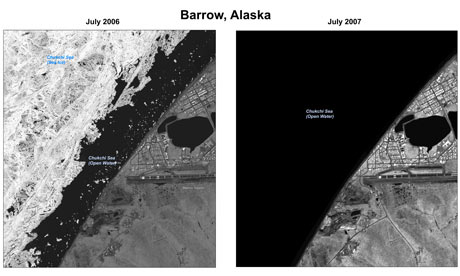
Graphic images that reveal the devastating impact of global warming in the Arctic have been released by the US military. The photographs, taken by spy satellites over the past decade, confirm that in recent years vast areas in high latitudes have lost their ice cover in summer months.
The pictures, kept secret by Washington during the presidency of George W Bush, were declassified by the White House last week. President Barack Obama is currently trying to galvanise Congress and the American public to take action to halt catastrophic climate change caused by rising levels of carbon dioxide in the atmosphere.
One particularly striking set of images - selected from the 1,000 photographs released - includes views of the Alaskan port of Barrow. One, taken in July 2006, shows sea ice still nestling close to the shore. A second image shows that by the following July the coastal waters were entirely ice-free.
The photographs demonstrate starkly how global warming is changing the Arctic. More than a million square kilometres of sea ice - a record loss - were missing in the summer of 2007 compared with the previous year.
Nor has this loss shown any sign of recovery. Ice cover for 2008 was almost as bad as for 2007, and this year levels look equally sparse.
"These are one-metre resolution images, which give you a big picture of the summertime Arctic," said Thorsten Markus of Nasa's Goddard Space Flight Centre. "This is the main reason why we are so thrilled about it. One-metre resolution is the dimension that's been missing."
Disappearing summer sea ice poses considerable dangers, scientists have warned. Ice shelves are used by animals such as polar bears as platforms for hunting seals and other sea creatures. Without them, they could starve. In addition, ice reflects solar radiation. Without that process, the Arctic sea could warm up even more. The phenomenon threatens to set off runaway heating of the planet, say climatologists.
The latest revelations have triggered warnings from scientists that they no longer have the funds to keep a comprehensive track of climate change. Last week the head of the US's National Oceanic and Atmospheric Administration (NOAA), Professor Jane Lubchenco, warned that the gathering of satellite data - crucial to predicting future climate changes - was now at "great risk" because America's ageing satellite fleet was not being replaced.
"Our primary focus is maintaining the continuity of climate observations, and those are at great risk right now because we don't have the resources to have satellites at the ready and taking the kinds of information that we need," said Lubchenco, who was appointed by Obama. "We are playing catch-up."
Even before her warning, scientists were saying that America, the world's scientific superpower, was virtually blinding itself to climate change by cutting funds to the environmental satellite programmes run by the Oceanic and Atmospheric Administration and Nasa. A report by the National Academy of Sciences this year warned that the environmental satellite network was at risk of collapse.
In February, a Nasa satellite carrying instruments to produce the first map of the Earth's carbon emissions crashed near Antarctica only three minutes after lift-off.
The satellite would have measured carbon emissions at 100,000 points around the planet every day, providing a wealth of data compared to the 100 or so fixed towers currently in operation in a land-based network.
The NOAA is under additional pressure to provide environmental data because of the re-emergence of the El Niño climate phenomenon, where warming of the tropical Pacific causes heatwaves, droughts and flooding around the world. June's land and sea surface temperatures were the second hottest on record, and scientists are predicting this will be the warmest decade in recorded history. The last major El Niño was in 1998, the hottest year in recorded history.
The Obama administration has already taken steps to tackle America's flagging scientific lead. The president's economic recovery plan allotted $170m (£100m) to help close the gaps in climate modelling. The NOAA is seeking an additional $390m in its 2010 budget to upgrade environmental satellites, and help make data more available to researchers and government officials.
Tuesday, July 14, 2009
Climate Change 'Will Cause Civilisation to Collapse'
Authoritative new study sets out a grim vision of shortages and violence – but amid all the gloom, there is some hope too
By Jonathan Owen
July 13, 2009 "The Independent" -- An effort on the scale of the Apollo mission that sent men to the Moon is needed if humanity is to have a fighting chance of surviving the ravages of climate change. The stakes are high, as, without sustainable growth, "billions of people will be condemned to poverty and much of civilisation will collapse".
This is the stark warning from the biggest single report to look at the future of the planet - obtained by The Independent on Sunday ahead of its official publication next month. Backed by a diverse range of leading organisations such as Unesco, the World Bank, the US army and the Rockefeller Foundation, the 2009 State of the Future report runs to 6,700 pages and draws on contributions from 2,700 experts around the globe. Its findings are described by Ban Ki-moon, Secretary-General of the UN, as providing "invaluable insights into the future for the United Nations, its member states, and civil society".
The impact of the global recession is a key theme, with researchers warning that global clean energy, food availability, poverty and the growth of democracy around the world are at "risk of getting worse due to the recession". The report adds: "Too many greedy and deceitful decisions led to a world recession and demonstrated the international interdependence of economics and ethics."
Although the future has been looking better for most of the world over the past 20 years, the global recession has lowered the State of the Future Index for the next 10 years. Half the world could face violence and unrest due to severe unemployment combined with scarce water, food and energy supplies and the cumulative effects of climate change.
And the authors of the report, produced by the Millennium Project - a think-tank formerly part of the World Federation of the United Nations Associations - set out a number of emerging environmental security issues. "The scope and scale of the future effects of climate change - ranging from changes in weather patterns to loss of livelihoods and disappearing states - has unprecedented implications for political and social stability."
But the authors suggest the threats could also provide the potential for a positive future for all. "The good news is that the global financial crisis and climate change planning may be helping humanity to move from its often selfish, self-centred adolescence to a more globally responsible adulthood... Many perceive the current economic disaster as an opportunity to invest in the next generation of greener technologies, to rethink economic and development assumptions, and to put the world on course for a better future."
Scientific and technological progress continues to accelerate. IBM promises a computer at 20,000 trillion calculations per second by 2011, which is estimated to be the speed of the human brain. And nanomedicine may one day rebuild damaged cells atom by atom, using nanobots the size of blood cells. But technological progress carries its own risks. "Globalisation and advanced technology allow fewer people to do more damage and in less time, so that possibly one day a single individual may be able to make and deploy a weapon of mass destruction."
The report also praises the web, which it singles out as "the most powerful force for globalisation, democratisation, economic growth, and education in history". Technological advances are cited as "giving birth to an interdependent humanity that can create and implement global strategies to improve the prospects for humanity".
The immediate problems are rising food and energy prices, shortages of water and increasing migrations "due to political, environmental and economic conditions", which could plunge half the world into social instability and violence. And organised crime is flourishing, with a global income estimated at $3 trillion - twice the military budgets of all countries in the world combined.
The effects of climate change are worsening - by 2025 there could be three billion people without adequate water as the population rises still further. And massive urbanisation, increased encroachment on animal territory, and concentrated livestock production could trigger new pandemics.
Although government and business leaders are responding more seriously to the global environmental situation, it continues to get worse, according to the report. It calls on governments to work to 10-year plans to tackle growing threats to human survival, targeting particularly the US and China, which need to apply the sort of effort and resources that put men on the Moon.
"This is not only important for the environment; it is also a strategy to increase the likelihood of international peace. Without some agreement, it will be difficult to get the kind of global coherence needed to address climate change seriously."
While the world has the resources to address its challenges, coherence and direction have been lacking. Recent meetings of the US and China, as well as of Nato and Russia, and the birth of the G20 plus the continued work of the G8 promise to improve global strategic collaboration, but "it remains to be seen if this spirit of co-operation can continue and if decisions will be made on the scale necessary to really address the global challenges discussed in this report".
Although the scale of the effects of climate change are unprecedented, the causes are generally known, and the consequences can largely be forecast. The report says, "coordination for effective and adequate action is yet incipient, and environmental problems worsen faster than response or preventive policies are being adopted".
Jerome Glenn, director of the Millennium Project and one of the report's authors, said: "There are answers to our global challenges, but decisions are still not being made on the scale necessary to address them. Three great transitions would help both the world economy and its natural environment - to shift as much as possible from freshwater agriculture to saltwater agriculture; produce healthier meat without the need to grow animals; and replace gasoline cars with electric cars."
©independent.co.uk
By Jonathan Owen
July 13, 2009 "The Independent" -- An effort on the scale of the Apollo mission that sent men to the Moon is needed if humanity is to have a fighting chance of surviving the ravages of climate change. The stakes are high, as, without sustainable growth, "billions of people will be condemned to poverty and much of civilisation will collapse".
This is the stark warning from the biggest single report to look at the future of the planet - obtained by The Independent on Sunday ahead of its official publication next month. Backed by a diverse range of leading organisations such as Unesco, the World Bank, the US army and the Rockefeller Foundation, the 2009 State of the Future report runs to 6,700 pages and draws on contributions from 2,700 experts around the globe. Its findings are described by Ban Ki-moon, Secretary-General of the UN, as providing "invaluable insights into the future for the United Nations, its member states, and civil society".
The impact of the global recession is a key theme, with researchers warning that global clean energy, food availability, poverty and the growth of democracy around the world are at "risk of getting worse due to the recession". The report adds: "Too many greedy and deceitful decisions led to a world recession and demonstrated the international interdependence of economics and ethics."
Although the future has been looking better for most of the world over the past 20 years, the global recession has lowered the State of the Future Index for the next 10 years. Half the world could face violence and unrest due to severe unemployment combined with scarce water, food and energy supplies and the cumulative effects of climate change.
And the authors of the report, produced by the Millennium Project - a think-tank formerly part of the World Federation of the United Nations Associations - set out a number of emerging environmental security issues. "The scope and scale of the future effects of climate change - ranging from changes in weather patterns to loss of livelihoods and disappearing states - has unprecedented implications for political and social stability."
But the authors suggest the threats could also provide the potential for a positive future for all. "The good news is that the global financial crisis and climate change planning may be helping humanity to move from its often selfish, self-centred adolescence to a more globally responsible adulthood... Many perceive the current economic disaster as an opportunity to invest in the next generation of greener technologies, to rethink economic and development assumptions, and to put the world on course for a better future."
Scientific and technological progress continues to accelerate. IBM promises a computer at 20,000 trillion calculations per second by 2011, which is estimated to be the speed of the human brain. And nanomedicine may one day rebuild damaged cells atom by atom, using nanobots the size of blood cells. But technological progress carries its own risks. "Globalisation and advanced technology allow fewer people to do more damage and in less time, so that possibly one day a single individual may be able to make and deploy a weapon of mass destruction."
The report also praises the web, which it singles out as "the most powerful force for globalisation, democratisation, economic growth, and education in history". Technological advances are cited as "giving birth to an interdependent humanity that can create and implement global strategies to improve the prospects for humanity".
The immediate problems are rising food and energy prices, shortages of water and increasing migrations "due to political, environmental and economic conditions", which could plunge half the world into social instability and violence. And organised crime is flourishing, with a global income estimated at $3 trillion - twice the military budgets of all countries in the world combined.
The effects of climate change are worsening - by 2025 there could be three billion people without adequate water as the population rises still further. And massive urbanisation, increased encroachment on animal territory, and concentrated livestock production could trigger new pandemics.
Although government and business leaders are responding more seriously to the global environmental situation, it continues to get worse, according to the report. It calls on governments to work to 10-year plans to tackle growing threats to human survival, targeting particularly the US and China, which need to apply the sort of effort and resources that put men on the Moon.
"This is not only important for the environment; it is also a strategy to increase the likelihood of international peace. Without some agreement, it will be difficult to get the kind of global coherence needed to address climate change seriously."
While the world has the resources to address its challenges, coherence and direction have been lacking. Recent meetings of the US and China, as well as of Nato and Russia, and the birth of the G20 plus the continued work of the G8 promise to improve global strategic collaboration, but "it remains to be seen if this spirit of co-operation can continue and if decisions will be made on the scale necessary to really address the global challenges discussed in this report".
Although the scale of the effects of climate change are unprecedented, the causes are generally known, and the consequences can largely be forecast. The report says, "coordination for effective and adequate action is yet incipient, and environmental problems worsen faster than response or preventive policies are being adopted".
Jerome Glenn, director of the Millennium Project and one of the report's authors, said: "There are answers to our global challenges, but decisions are still not being made on the scale necessary to address them. Three great transitions would help both the world economy and its natural environment - to shift as much as possible from freshwater agriculture to saltwater agriculture; produce healthier meat without the need to grow animals; and replace gasoline cars with electric cars."
©independent.co.uk
Thursday, July 2, 2009
Exxon funding climate BS still ~
The world's largest oil company is continuing to fund lobby groups that question the reality of global warming, despite a public pledge to cut support for such climate change denial, a new analysis shows.
Company records show that ExxonMobil handed over hundreds of thousands of pounds to such lobby groups in 2008. These include the National Center for Policy Analysis (NCPA) in Dallas, Texas, which received $75,000 (£45,500), and the Heritage Foundation in Washington DC, which received $50,000.
According to Bob Ward, policy and communications director at the Grantham Research Institute on Climate Change and the Environment, at the London School of Economics, both the NCPA and the Heritage Foundation have published "misleading and inaccurate information about climate change."
On its website, the NCPA says: "NCPA scholars believe that while the causes and consequences of the earth's current warming trend is [sic] still unknown, the cost of actions to substantially reduce CO2 emissions would be quite high and result in economic decline, accelerated environmental destruction, and do little or nothing to prevent global warming regardless of its cause."
The Heritage Foundation published a "web memo" in December that said: "Growing scientific evidence casts doubt on whether global warming constitutes a threat, including the fact that 2008 is about to go into the books as a cooler year than 2007". Scientists, including those at the UK Met Office say that the apparent cooling is down to natural changes and does not alter the long-term warming trend.
In its 2008 corporate citizenship report, published last year, ExxonMobil said it would cut funds to several groups that "divert attention" from the need to find new sources of clean energy.
The NCPA and Heritage Foundation are included among groups funded by ExxonMobil, according to details of its "2008 Worldwide Contributions and Community Investments" published recently.
Ward said: "ExxonMobil has been briefing journalists for three years that they were going to stop funding these groups. The reality is that they are still doing it. If the world's largest oil company wants to fund climate change denial then it should be upfront about it, and not tell people it has stopped."
In 2006, Ward, then at the Royal Society, wrote to ExxonMobil to challenge the company's funding of such lobby groups. The move, revealed in the Guardian, prompted accusations of censorship and debate about whether experts should "police" the distribution of scientific information.
In an article on the Guardian website, Ward writes: "I have now written again to ExxonMobil to point out that these organisations publish misleading information about climate change on their websites, and to seek guidance on how to reconcile this fact with the pledge made by the company. I believe that the company should keep its promise by ending its financial support for lobby groups that mislead the public about climate change."
ExxonMobil said it annually reviews and adjusts its contributions to policy research groups. A spokesman said: "Only ExxonMobil speaks for ExxonMobil and our position on climate change is clear. We have the same concerns as people everywhere, and that is how to provide the world with the energy it needs while reducing greenhouse gas emissions. We take the issue of climate change seriously and the risks warrant action."
Company records show that ExxonMobil handed over hundreds of thousands of pounds to such lobby groups in 2008. These include the National Center for Policy Analysis (NCPA) in Dallas, Texas, which received $75,000 (£45,500), and the Heritage Foundation in Washington DC, which received $50,000.
According to Bob Ward, policy and communications director at the Grantham Research Institute on Climate Change and the Environment, at the London School of Economics, both the NCPA and the Heritage Foundation have published "misleading and inaccurate information about climate change."
On its website, the NCPA says: "NCPA scholars believe that while the causes and consequences of the earth's current warming trend is [sic] still unknown, the cost of actions to substantially reduce CO2 emissions would be quite high and result in economic decline, accelerated environmental destruction, and do little or nothing to prevent global warming regardless of its cause."
The Heritage Foundation published a "web memo" in December that said: "Growing scientific evidence casts doubt on whether global warming constitutes a threat, including the fact that 2008 is about to go into the books as a cooler year than 2007". Scientists, including those at the UK Met Office say that the apparent cooling is down to natural changes and does not alter the long-term warming trend.
In its 2008 corporate citizenship report, published last year, ExxonMobil said it would cut funds to several groups that "divert attention" from the need to find new sources of clean energy.
The NCPA and Heritage Foundation are included among groups funded by ExxonMobil, according to details of its "2008 Worldwide Contributions and Community Investments" published recently.
Ward said: "ExxonMobil has been briefing journalists for three years that they were going to stop funding these groups. The reality is that they are still doing it. If the world's largest oil company wants to fund climate change denial then it should be upfront about it, and not tell people it has stopped."
In 2006, Ward, then at the Royal Society, wrote to ExxonMobil to challenge the company's funding of such lobby groups. The move, revealed in the Guardian, prompted accusations of censorship and debate about whether experts should "police" the distribution of scientific information.
In an article on the Guardian website, Ward writes: "I have now written again to ExxonMobil to point out that these organisations publish misleading information about climate change on their websites, and to seek guidance on how to reconcile this fact with the pledge made by the company. I believe that the company should keep its promise by ending its financial support for lobby groups that mislead the public about climate change."
ExxonMobil said it annually reviews and adjusts its contributions to policy research groups. A spokesman said: "Only ExxonMobil speaks for ExxonMobil and our position on climate change is clear. We have the same concerns as people everywhere, and that is how to provide the world with the energy it needs while reducing greenhouse gas emissions. We take the issue of climate change seriously and the risks warrant action."
Tuesday, June 30, 2009
"freedom of speech" versus "the quest for the truth"
I thought we discovered that if we started out with "truth" our lives would end in doubt whereas if we started out with doubt we might discover some certainity.
The relationship between global temps and carbon dioxide levels has been inferred for 150 years and clearly identified in the last thirty by analysis of ice cores. We know the earth is a dynamic system and not all answers are in but prudent risk management would imply that we should try to put some upper limit on the scale of our global pyromania.
The "Enemies of the people" are not the climatologists they are those that don't want facts to cloud their bottom line.
Do I beleive those that applaud climate change denial are "Betraying the Planet",hmm difficult. The planet is on its last legs, having survived a few billion years of dim sunlight by running warm it now swims in light 30% brighter than those early days by running cool. The sun actually gets much hotter from here on so maybe the biosphere has only a few hundred million years left in it before UV starts breaking up water in the upper atmosphere. The planets in good shape but as its running out of biosphere reboots, if the mad monkeys mess it up, a second shot at intelligent primates capable of a technological civilisation is by no means certain.
I do therefore believe the denialists are calling for our premature and abrupt ejection from the wonderfull Eden of the "holocene sweet spot". But most of all I beleive that if we don't trust our greatest pointer to truth, the scientific method, we betray our whole civilisation. The debate was sullied by twenty years of misinformation, astro turfing, denial and political hardball by the owners of an energy system with an net impact on the natural planetary processes of temperature management. When we are dealing with an energy system that drives geopolitics and where control of the commanding heights of the economy are at stake the "enemy of the people" isn't likely to be a few hundred climate scientists preaching caution, its much more likely to be those with money and power who say push on, don't worry.....
I am disgusted by the arguments, methods and hubris of the denialists and those who would comprimise with them. I am therefore "an enemy of the people" in Ibsen's sense.
As for me, more than money, or fame, or anything else, I have always prized the truth.
And the truth is Krugman is right.
Well, sometimes even the most authoritative analyses get things wrong. And if dissenting opinion-makers and politicians based their dissent on hard work and hard thinking — if they had carefully studied the issue, consulted with experts and concluded that the overwhelming scientific consensus was misguided — they could at least claim to be acting responsibly.
But if you watched the debate on Friday, you didn’t see people who’ve thought hard about a crucial issue, and are trying to do the right thing. What you saw, instead, were people who show no sign of being interested in the truth. They don’t like the political and policy implications of climate change, so they’ve decided not to believe in it — and they’ll grab any argument, no matter how disreputable, that feeds their denial.
Indeed, if there was a defining moment in Friday’s debate, it was the declaration by Representative Paul Broun of Georgia that climate change is nothing but a “hoax” that has been “perpetrated out of the scientific community.” I’d call this a crazy conspiracy theory, but doing so would actually be unfair to crazy conspiracy theorists. After all, to believe that global warming is a hoax you have to believe in a vast cabal consisting of thousands of scientists — a cabal so powerful that it has managed to create false records on everything from global temperatures to Arctic sea ice.
Yet Mr. Broun’s declaration was met with applause.
Given this contempt for hard science, I’m almost reluctant to mention the deniers’ dishonesty on matters economic. But in addition to rejecting climate science, the opponents of the climate bill made a point of misrepresenting the results of studies of the bill’s economic impact, which all suggest that the cost will be relatively low.
Still, is it fair to call climate denial a form of treason? Isn’t it politics as usual?
Yes, it is — and that’s why it’s unforgivable.
Do you remember the days when Bush administration officials claimed that terrorism posed an “existential threat” to America, a threat in whose face normal rules no longer applied? That was hyperbole — but the existential threat from climate change is all too real.
Yet the deniers are choosing, willfully, to ignore that threat, placing future generations of Americans in grave danger, simply because it’s in their political interest to pretend that there’s nothing to worry about. If that’s not betrayal, I don’t know what is.
The relationship between global temps and carbon dioxide levels has been inferred for 150 years and clearly identified in the last thirty by analysis of ice cores. We know the earth is a dynamic system and not all answers are in but prudent risk management would imply that we should try to put some upper limit on the scale of our global pyromania.
The "Enemies of the people" are not the climatologists they are those that don't want facts to cloud their bottom line.
Do I beleive those that applaud climate change denial are "Betraying the Planet",hmm difficult. The planet is on its last legs, having survived a few billion years of dim sunlight by running warm it now swims in light 30% brighter than those early days by running cool. The sun actually gets much hotter from here on so maybe the biosphere has only a few hundred million years left in it before UV starts breaking up water in the upper atmosphere. The planets in good shape but as its running out of biosphere reboots, if the mad monkeys mess it up, a second shot at intelligent primates capable of a technological civilisation is by no means certain.
I do therefore believe the denialists are calling for our premature and abrupt ejection from the wonderfull Eden of the "holocene sweet spot". But most of all I beleive that if we don't trust our greatest pointer to truth, the scientific method, we betray our whole civilisation. The debate was sullied by twenty years of misinformation, astro turfing, denial and political hardball by the owners of an energy system with an net impact on the natural planetary processes of temperature management. When we are dealing with an energy system that drives geopolitics and where control of the commanding heights of the economy are at stake the "enemy of the people" isn't likely to be a few hundred climate scientists preaching caution, its much more likely to be those with money and power who say push on, don't worry.....
I am disgusted by the arguments, methods and hubris of the denialists and those who would comprimise with them. I am therefore "an enemy of the people" in Ibsen's sense.
As for me, more than money, or fame, or anything else, I have always prized the truth.
And the truth is Krugman is right.
Well, sometimes even the most authoritative analyses get things wrong. And if dissenting opinion-makers and politicians based their dissent on hard work and hard thinking — if they had carefully studied the issue, consulted with experts and concluded that the overwhelming scientific consensus was misguided — they could at least claim to be acting responsibly.
But if you watched the debate on Friday, you didn’t see people who’ve thought hard about a crucial issue, and are trying to do the right thing. What you saw, instead, were people who show no sign of being interested in the truth. They don’t like the political and policy implications of climate change, so they’ve decided not to believe in it — and they’ll grab any argument, no matter how disreputable, that feeds their denial.
Indeed, if there was a defining moment in Friday’s debate, it was the declaration by Representative Paul Broun of Georgia that climate change is nothing but a “hoax” that has been “perpetrated out of the scientific community.” I’d call this a crazy conspiracy theory, but doing so would actually be unfair to crazy conspiracy theorists. After all, to believe that global warming is a hoax you have to believe in a vast cabal consisting of thousands of scientists — a cabal so powerful that it has managed to create false records on everything from global temperatures to Arctic sea ice.
Yet Mr. Broun’s declaration was met with applause.
Given this contempt for hard science, I’m almost reluctant to mention the deniers’ dishonesty on matters economic. But in addition to rejecting climate science, the opponents of the climate bill made a point of misrepresenting the results of studies of the bill’s economic impact, which all suggest that the cost will be relatively low.
Still, is it fair to call climate denial a form of treason? Isn’t it politics as usual?
Yes, it is — and that’s why it’s unforgivable.
Do you remember the days when Bush administration officials claimed that terrorism posed an “existential threat” to America, a threat in whose face normal rules no longer applied? That was hyperbole — but the existential threat from climate change is all too real.
Yet the deniers are choosing, willfully, to ignore that threat, placing future generations of Americans in grave danger, simply because it’s in their political interest to pretend that there’s nothing to worry about. If that’s not betrayal, I don’t know what is.
Thursday, June 25, 2009
Action on global warming? No new science required..
Power Struggle
by Bradford Plumer
Do we need a technological breakthrough to avert the climate crisis?
A substantial body of evidence suggests that the world can make huge emission cuts in the next few decades without needing to wait for grandiose new technologies to arrive. In 2004, two Princeton scientists, Stephen Pacala and Robert Socolow, published a much-discussed paper in Science laying out 15 carbon-cutting strategies that have already been field-tested, which they dubbed "wedges." Solar power constituted one wedge, nuclear another, stricter fuel-economy standards for cars a third, reversing deforestation a fourth, and so on. The world, Pacala and Socolow showed, could cut emissions dramatically and still satisfy growing energy demand by deploying just seven of those wedges on a grand scale. (That's no mean task: One "wedge" of nuclear power, say, would mean building 21 new plants each year between now and 2050.) While some experts now believe we need even more wedges to meet the ipcc targets, several research efforts have reached similar conclusions: By combining everything we now have on hand, we can tackle a sizeable chunk of the problem at a reasonable cost. A 2008 McKinsey Global Institute analysis pegged the investments needed by 2030 at around 0.6 to 1.4 percent of global GDP and noted that the impact on the world's economic growth rate would be minimal, "even with currently known technologies."
The IPCC lists a wide array of technologies either available now or very likely to surface in the near future that could help reduce emissions. The former category includes (among other things) nuclear power, hydropower, wind power, geothermal, fuel-efficient vehicles, hybrids, biofuels, public transit, reforestation, and landfill methane recovery. The list of just-around-the- corner strategies includes carbon sequestration for coal-fired plants, advanced nuclear plants, tidal and wave power, cellulosic biofuels, and advanced electric vehicles. While no single solution will make more than a modest dent in the world's emissions--none of those items has the vast potential of, say, artificial photosynthesis--when combined together, they should steadily chip away at carbon emissions.
One particularly promising example is solar thermal power, in which large arrays of mirrors heat a liquid that can either generate electricity or be stored for when it's cloudy or dark. Such plants are being built now, and, if Congress passed a carbon price that made them more competitive with coal and natural-gas plants, they'd become even more prevalent and the price would continue nudging downward: The National Renewable Energy Laboratory has already estimated that these plants will be able to compete with existing natural-gas plants by 2015, and solar-power expert Ken Zweibel has estimated that they could, in theory, supply up to 69 percent of America's electricity by 2050. It would require a fair amount of government support and infrastructure investments, as well as further R&D, but not a whole new level of science. In the short term, meanwhile, one of the biggest reductions in emissions will come from making buildings and homes more energy-efficient, which typically requires no fancy new technology at all--just smarter regulations.
It's true that, eventually, existing technologies will hit a wall. If electric cars powered by lithium-ion batteries become widespread, for instance, then world lithium supplies could conceivably dwindle. Or, at a certain point, the need for cost-effective electrical-power storage could become a serious issue. (Right now, Denmark gets nearly 20 percent of its electricity from wind, but can only "store" that power by exporting the excess to Sweden and Norway, which send back hydropower when the wind isn't blowing-- a clever workaround that will prove less feasible as renewables spread.) "There are a bunch of things we know how to do now, and we want to use all the incentives we can to get those things out there," says Argonne's George Crabtree. "But, eventually, their impact will saturate, as soon as they're fully deployed--and that's where you'll need serious innovation."
By mid-century or so, we really may need the sorts of artificial leaves and futuristic batteries we can barely begin to imagine right now. And it is far less outlandish to expect that, by that time, science will be able to deliver such breakthroughs. But all of those sci-fi technologies decades from now won't mean much if we've long since blown past our carbon budget. That means doing as much as we can now--and fast.
http://www.tnr.com/politics/story.html?id=532df6a0-27db-420d-8480-25e229618117&p=2
by Bradford Plumer
Do we need a technological breakthrough to avert the climate crisis?
A substantial body of evidence suggests that the world can make huge emission cuts in the next few decades without needing to wait for grandiose new technologies to arrive. In 2004, two Princeton scientists, Stephen Pacala and Robert Socolow, published a much-discussed paper in Science laying out 15 carbon-cutting strategies that have already been field-tested, which they dubbed "wedges." Solar power constituted one wedge, nuclear another, stricter fuel-economy standards for cars a third, reversing deforestation a fourth, and so on. The world, Pacala and Socolow showed, could cut emissions dramatically and still satisfy growing energy demand by deploying just seven of those wedges on a grand scale. (That's no mean task: One "wedge" of nuclear power, say, would mean building 21 new plants each year between now and 2050.) While some experts now believe we need even more wedges to meet the ipcc targets, several research efforts have reached similar conclusions: By combining everything we now have on hand, we can tackle a sizeable chunk of the problem at a reasonable cost. A 2008 McKinsey Global Institute analysis pegged the investments needed by 2030 at around 0.6 to 1.4 percent of global GDP and noted that the impact on the world's economic growth rate would be minimal, "even with currently known technologies."
The IPCC lists a wide array of technologies either available now or very likely to surface in the near future that could help reduce emissions. The former category includes (among other things) nuclear power, hydropower, wind power, geothermal, fuel-efficient vehicles, hybrids, biofuels, public transit, reforestation, and landfill methane recovery. The list of just-around-the- corner strategies includes carbon sequestration for coal-fired plants, advanced nuclear plants, tidal and wave power, cellulosic biofuels, and advanced electric vehicles. While no single solution will make more than a modest dent in the world's emissions--none of those items has the vast potential of, say, artificial photosynthesis--when combined together, they should steadily chip away at carbon emissions.
One particularly promising example is solar thermal power, in which large arrays of mirrors heat a liquid that can either generate electricity or be stored for when it's cloudy or dark. Such plants are being built now, and, if Congress passed a carbon price that made them more competitive with coal and natural-gas plants, they'd become even more prevalent and the price would continue nudging downward: The National Renewable Energy Laboratory has already estimated that these plants will be able to compete with existing natural-gas plants by 2015, and solar-power expert Ken Zweibel has estimated that they could, in theory, supply up to 69 percent of America's electricity by 2050. It would require a fair amount of government support and infrastructure investments, as well as further R&D, but not a whole new level of science. In the short term, meanwhile, one of the biggest reductions in emissions will come from making buildings and homes more energy-efficient, which typically requires no fancy new technology at all--just smarter regulations.
It's true that, eventually, existing technologies will hit a wall. If electric cars powered by lithium-ion batteries become widespread, for instance, then world lithium supplies could conceivably dwindle. Or, at a certain point, the need for cost-effective electrical-power storage could become a serious issue. (Right now, Denmark gets nearly 20 percent of its electricity from wind, but can only "store" that power by exporting the excess to Sweden and Norway, which send back hydropower when the wind isn't blowing-- a clever workaround that will prove less feasible as renewables spread.) "There are a bunch of things we know how to do now, and we want to use all the incentives we can to get those things out there," says Argonne's George Crabtree. "But, eventually, their impact will saturate, as soon as they're fully deployed--and that's where you'll need serious innovation."
By mid-century or so, we really may need the sorts of artificial leaves and futuristic batteries we can barely begin to imagine right now. And it is far less outlandish to expect that, by that time, science will be able to deliver such breakthroughs. But all of those sci-fi technologies decades from now won't mean much if we've long since blown past our carbon budget. That means doing as much as we can now--and fast.
http://www.tnr.com/politics/story.html?id=532df6a0-27db-420d-8480-25e229618117&p=2
Sunday, June 21, 2009
CO2 currently at highest level in 2.1 million years
Atmospheric carbon dioxide levels are higher than any point in the last 2.1 million years, report researchers writing in the journal Science.
Analyzing the shells of single-celled plankton buried under the Atlantic Ocean off the coast of Africa, Bärbel Hönisch, a geochemist at Columbia University's Lamont-Doherty Earth Observatory, and her colleagues dtermined that peak CO2 levels over the last 2.1 million years averaged only 280 parts per million. By comparison current CO2 levels stand at 385 parts per million, or 38% higher than the long-term peak.
Annual mean atmospheric CO2 concentrations (ppm), 1850-2008 [top]; Monthly atmospheric CO2 records from sites in the SIO air sampling network 2005-June 2009 [bottom].
The findings provide new insight on the role of CO2 in global cycles of cooling and warming, suggesting that a shift towards longer glacial cycles — producing a major ice age about every 100,000 years instead of every 40,000 — some 1.2 million to 500,000 years ago was the result not of declining CO2 levels, but another factor, perhaps Earth's orbit and tilt, which determines how much sunlight falls on each hemisphere, or changes in how previous ice ages affected subsequent ice ages.
"Previous studies indicated that CO2 did not change much over the past 20 million years, but the resolution wasn't high enough to be definitive," said Hönisch. "This study tells us that CO2 was not the main trigger, though our data continues to suggest that greenhouse gases and global climate are intimately linked."
B. Hönisch et al. Atmospheric Carbon Dioxide Concentration Across the Mid-Pleistocene Transition. SCIENCE VOL 324 19 JUNE 2009
http://news.mongabay.com/2009/0618-co2.html
Analyzing the shells of single-celled plankton buried under the Atlantic Ocean off the coast of Africa, Bärbel Hönisch, a geochemist at Columbia University's Lamont-Doherty Earth Observatory, and her colleagues dtermined that peak CO2 levels over the last 2.1 million years averaged only 280 parts per million. By comparison current CO2 levels stand at 385 parts per million, or 38% higher than the long-term peak.
Annual mean atmospheric CO2 concentrations (ppm), 1850-2008 [top]; Monthly atmospheric CO2 records from sites in the SIO air sampling network 2005-June 2009 [bottom].
The findings provide new insight on the role of CO2 in global cycles of cooling and warming, suggesting that a shift towards longer glacial cycles — producing a major ice age about every 100,000 years instead of every 40,000 — some 1.2 million to 500,000 years ago was the result not of declining CO2 levels, but another factor, perhaps Earth's orbit and tilt, which determines how much sunlight falls on each hemisphere, or changes in how previous ice ages affected subsequent ice ages.
"Previous studies indicated that CO2 did not change much over the past 20 million years, but the resolution wasn't high enough to be definitive," said Hönisch. "This study tells us that CO2 was not the main trigger, though our data continues to suggest that greenhouse gases and global climate are intimately linked."
B. Hönisch et al. Atmospheric Carbon Dioxide Concentration Across the Mid-Pleistocene Transition. SCIENCE VOL 324 19 JUNE 2009
http://news.mongabay.com/2009/0618-co2.html
Saturday, June 20, 2009
Reviewing Pilmer ~ A geology giant gone off the rails on warming
David Karoly: Ian Plimer's new book Heaven + Earth claims to shed new light on the science of climate change. It states that 'human-induced global warming has evolved into a religious belief system', that 'atmospheric carbon dioxided does not create a temperature rise' and that 'global warming and a high CO2 content bring prosperity and lengthen your life'.
Are these claims justified and based on science? They are in marked contrast to the scientific understanding of the causes of recent climate change reported in the assessments of the Intergovernmental Panel on Climate Change (often referred to as the IPCC), as well as by other scientific bodies including the US National Academies, the British Royal Society and the Australian Academy of Science. They have all reached the same conclusion; that the observed increase in global-average surface temperature since the mid-20th century is mainly due to the increase in greenhouse gases in the atmosphere, caused by human activity.
Heaven + Earth claims that this conclusion and almost all the conclusions of the IPCC are wrong. It suggests that there is a conspiracy amongst climate scientists to hide the 'truth' and that the learned scientific societies of many countries have been hoodwinked. He implies that this conspiracy involves all the hundred-plus national governments that unanimously approved the conclusions of the IPCC assessments. Not surprisingly, the book has attracted attention from the media, politicians and some scientists, as well as the public. Nothing sells like a good conspiracy story.
But is this book the story of a conspiracy, or even a good read? Is it about science or is it science fiction? The book is impressive and possibly interesting, but very disappointing. Impressive because of the time and effort that must have been spent writing the 500 pages with 2,000-plus footnotes. Interesting because it seeks to link many aspects of geology, astronomy, biology, glaciology, oceanography and meteorology to explain climate change over the Earth's multi-billion-year history, including the last hundred years. It's disappointing because a senior professor should not have produced such a book with so many errors, so many internal inconsistencies, and with no sources for its graphs.
The average reader will find it difficult to sort the fact from the fiction, to disentangle the inconsistencies, and separate the personal opinions and interpretations of the author from the well-established science. The book is built around six sections that consider history, the Sun, earth, ice, water, and air. In these, 18 questions are considered, and many scientists would agree with some aspects of the answers presented. However, there are major errors in many of the answers, making the conclusions invalid. The best description of the problems with the book is provided by Plimer himself. He writes, 'Trying to deal with these misrepresentations is somewhat like trying to argue with creationists, who misquote, concoct evidence, quote out of context, ignore contrary evidence, and create evidence ex nihilo.'
There are some sensible things in Heaven + Earth. Yes, it is important to 'look at climate over geological, archaeological, historical and modern time'. Throughout Earth's history there have been natural climate variations driven by many factors, including variations in the Earth's orbit around the Sun, volcanic eruptions, tectonics, and changes in greenhouse gas concentrations. For most of Earth's history, global temperatures and carbon dioxide concentrations in the atmosphere have been higher than present. Plimer is wrong to claim that 'the IPCC has essentially ignored the role of natural climate variability', as natural climate variability is carefully considered in all four of the IPCC's comprehensive assessments since 1990. In its 2007 report, a whole chapter on palaeoclimate focuses on natural climate variations over Earth's history. Yes, water vapour is the most important greenhouse gas in the atmosphere. However, as Plimer states, 'Water vapour tends to follow temperature change rather than cause it,' so water vapour changes cannot initiate climate change.
Now let me address some of the major scientific flaws in Plimer's arguments. He claims 'it is not possible to ascribe a carbon dioxide increase to human activity' and 'volcanoes produce more CO2 than the world's cars and industries combined'. Both are wrong. Burning fossil fuels produces carbon dioxide enriched with carbon isotope 12C and reduced 13C and essentially no 14C, and it decreases atmospheric oxygen, exactly as observed and as Plimer states on pages 414 and 415. Scientists have estimated emissions from volcanoes on land for the last 50 years and they are small compared with total global emissions from human sources.
Plimer even argues that the recent sources must be underwater volcanoes. This is not the case, because the net movement of carbon dioxide is from the atmosphere to the ocean, based on measurements that the concentration of dissolved carbon dioxide in the ocean is less than in the atmosphere. In addition, measurements show that the concentrations of two other long-lived greenhouse gases with human-related sources, methane and nitrous oxide, have increased markedly over the last 200 years, at the same time as the increases in carbon dioxide. This is not possible due to sources from underwater volcanoes.
Next, he states that CO2 does not drive climate. He then contradicts himself by writing 'CO2 keeps our planet warm so that it is not covered in ice'. There is ample geological evidence of increased CO2 causing climate change, such as the Palaeocene-Eocene thermal maximum about 55 million years ago. He writes 'land and sea temperatures increased by five to ten degrees with associated extinctions of life' when methane was released into the atmosphere due to geological processes and rapidly converted to CO2.
Plimer writes repeatedly that global warming ended in 1998, that the warmth of the last few decades is not unusual, and that satellite measurements show there has been no global warming since 1979. He is correct that on time scales of the last 100 million years, the recent global-scale warmth is not unusual. However, it is unusual over at least the last 1,000 years, including the Medieval warming. Plimer makes the mistake of using local temperatures from proxy evidence rather than considering data from the whole globe at the same time. The report of the US National Academy of Sciences in 2006, cited by Plimer, states 'Presently available proxy evidence indicates that temperatures at many, but not all individual locations, were higher during the past 25 years than during any period of comparable length since AD 900.'
We do not expect significant warming to always occur for short periods, such as since 1998. Natural climate variations are more important over short periods, with El Nino causing hotter global-average temperatures in 1998 and La Nina cooler global temperatures in 2007 and 2008. Global-average temperature for the current decade from surface observations and from satellite data is warmer than any other decade with reasonable data coverage. Plimer is wrong to write 'Not one of the IPCC models predicted that there would be cooling after 1998'. Actually, more than one-fifth of climate models show cooling in global average temperatures for the period from 1998 to 2008.
Plimer writes that solar activity accounts for some 80% of the global temperature trend over the last 150 years. This doesn't fit the observational evidence. Increases in solar irradiance would cause more warming in the daytime, in the tropics and in summer, as well as warming in the upper atmosphere, and these are not observed. Changes in solar irradiance and cosmic rays show a large 11-year sunspot cycle and negligible trend, but observed global temperatures show a large warming trend and small 11-year cycle.
Plimer is wrong again when he writes 'An enrichment in atmospheric CO2 is not even a little bit bad for life on Earth. It is wholly beneficial.' This is contradicted when he writes that the Palaeocene-Eocene thermal maximum was associated with mass extinctions. There are many other errors, both large and small, including volcanoes emitting CFCs and that the Sun consists mainly of the same elements as the rocky planets. Many of the figures have mistakes, either in the caption or in the data, and have no sources provided.
Given the errors, the non-science, and the nonsense in this book, it should be classified as science fiction in any library that wastes its funds buying it. The book can then be placed on the shelves alongside Michael Crichton's State of Fear, another science fiction book about climate change with many footnotes. The only difference is that there are fewer scientific errors in State of Fear.
Robyn Williams: David Karoly is a Federation Fellow at the University of Melbourne. He was reviewing Ian Plimer's book Heaven + Earth, now in the bestseller lists.
http://mpegmedia.abc.net.au/rn/podcast/2009/06/ssw_20090613_1205.mp3
Robyn Williams: Ian Plimer's book Heaven and Earth has been high up in the bestseller list for three or four weeks now. His unswerving dismissal of climate change orthodoxy should come as a surprise to those of us in the general public who expect science to get its facts right, especially in matters which really count, because the stakes couldn't really be higher.
So what's going on? How could one of our best-known geologists, together with some of his like-minded colleagues, be so much at odds with all the leading journals, the academies and most of the specialists in climate studies? We've already had one review on this week in The Science Show about earth scientist Professor Malcolm Walter, and it can still be heard online.
Today, for Ockham's Razor, we have one of Australia's top scientists, whose job is to assess the merits of research across the nation.
Professor Kurt Lambeck is president of the Australian Academy of Science.
Kurt Lambeck: I'm an earth scientist whose research is directed at the interactions between the solid earth, the oceans, ice sheets and atmosphere. And this research is directed not merely to interpret the geological record, but to distinguish between cause and effect, and to understand what may happen when natural and anthropogenic forces clash. In recent years my research has been on sea level change from millions of years to recent times. And this has included geological field work in Australia, Europe, Antarctica, Greenland, amongst other areas, and has given me some insight into at least this one aspect of climate change.
I believe this allows me to conclude that Heaven and Earth is not a work of science, it is an opinion of an author who happens to be a scientist.
There is no dispute that the geological record shows that climate change has occurred throughout the earth's history. The dispute is over whether the modern record can be understood in terms of the natural background processes or whether there is a new human factor that changes the rules about climate change.
To address this requires more than geological insight. It requires an understanding of the underlying physical, chemical and biological processes and an ability to model them so as to test alternative hypotheses. To say that geology is the only way to integrate all aspects of the environment is like saying that physicists and chemists should not get involved in biology. How can I take this advice seriously when I see other geologists proclaim with equal conviction, that the record points to imminent planetary doom because of human action?
No single discipline is equipped to handle the complex problems of climate change. Probably nowhere is it more important for the disciplines to come together than in understanding how the components of the solid earth, the oceans, atmosphere and ice sheets, feed off each other and interact in their response to internal and external forcing mechanisms. No single institution and certainly no single individual can do this alone. The problem is simply too complex and this is why processes such as the IPCC are important.
I have been part of the IPCC process and I know that's it's not a perfect one. In seeking consensus, extremes are filtered out. What happens to non-consensus views is that they get tested in the peer-reviewed literature, and if the hypothesis stands up to this probing, it becomes incorporated in subsequent analyses. If it fails to stand up, it will be ignored by the scientific community until new evidence comes to light.
Thus an important part of the synthesis process is that it is an iterative one and if one looks at the successive assessments, one can identify shifts and critiques that have led over time, to improvements in the understanding of climate change.
It is important to recognise that scientists are not consensus animals. We are all driven by our own demons: the satisfaction of being able to understand a particularly complex question, a desire to use science to improve the human condition; a search for recognition and fame and the next Nobel prize or a search for notoriety in the public gallery. Thus the concept that hundreds of researchers are conspiring to defraud the world's policy-makers requires a level of conspiracy theory that not even Dan Brown has reached.
Professor Plimer has said that Heaven and Earth is not written for the scientists but for the general public. This is an important objective but it is not an excuse for sloppy science or for the misrepresentation of science. I focus here on the section on sea level, because in his public discussions he has extensively used this to argue that all change is 'natural'.
If this had been written by an honours student, I would have failed it with the comment: You have obviously trawled through a lot of material but the critical analysis is missing. Supporting arguments and unsupported arguments in the literature are not distinguished or properly referenced, and you have left the impression that you have not developed an understanding of the processes involved. Rewrite!
I would then identify a number of specific issues which, while in isolation could be seen as minor, collectively indicate carelessness at best, and at worst an attempt to undermine the integrity of the science case. Here are just a few examples.
There is geological evidence that suggests that the Earth has gone through extreme glacial episodes in the distant past. Plimer states that change from extreme glacial to extreme warm conditions occurred within a few centuries. Whether this is correct or not is a legitimate point of debate. But further on, he states that to raise sea level by 4 to 6 metres from the melting of West Antarctica, in the near future, is Hollywood fantasy. That may well be true. But there is no consistency in his argument. If at one time the planet can exit from near-global glaciation conditions in a few hundred years, then why can a comparatively minor adjustment of the West Antarctica ice sheet not occur on the same time scale? Is it a case of seeing only what you want to see?
Plimer uses the example of ocean floor doming and sea floor volcanism to illustrate geological processes that have modified sea level. He states that during such events monstrous amounts of heat are released into the oceans and that huge volumes of water are displaced, causing sea level to rise. If I use his example of a 1000km x 1000km plateau raised by 1 kilometre, the volume of displaced water is about one million cubic kilometres, which when distributed over the oceans brings sea level up by about 3 metres. But the formation of these plateaux occur on a time scale of a million years and longer, and the associated rate of change is only of the order say, .03 millimetres per year, and this is about 100 times less than the rates observed today. Likewise, Plimer's monstrous amounts of heat released into the oceans do not produce a measurable global signal on the human time scale.
Much research has gone into modelling those kinds of earth deformation in order to understand the long-term, sea-level effects, and realistic order of magnitude estimates can be made. While impressive when viewed on the geological time scales, changes of 100-200 metres over 1 to 100 million years, imply rates of change that are insignificant when compared with the modern record of sea level change.
None of this research is referred to. Instead, he states that models for present sea level rise do not take them into consideration. The peer-reviewed scientific debate is extensive and combative, but there is an accepted conclusion that modern sea level rise, corrected for the geological background signals, can only be explained by a major contribution from thermal expansion of the oceans and from melting of mountain glaciers, and that both of these changes are consistent with the observed and modelled temperature changes during the past century.
Much is made in the book of the difficulty in reaching a reliable assessment of the modern sea-level rise from the instrumental record. From my own work, I agree that the analysis is difficult and not without pitfalls and that in the past different conclusions have been reached because some of these pitfalls were not recognised. But with time these have been addressed, new data has been identified, and analysis methods have improved. To argue therefore that because there are discrepancies with superseded results we cannot believe any of the results is to take a strange view of the process of science. There is in fact a quite remarkable convergence of the interpretation of the observational evidence of what has been happening to sea level in the past 100 or so years. This points to an increase in the globally averaged rates by a factor of about 2, and this is consistent with what is expected from the climate models that include both natural and anthropogenic forcing. None of this is discussed in the book.
To give his arguments a semblance of respectability the book is replete with references. But the choice is very selective. Plimer will quote, for example, a paper that appears to support his argument, but then he does not mention that the conclusions therein have been completely refuted in subsequent papers. Elsewhere, he refers to a specific question raised in published work but does not mention that this issue has subsequently been resolved, has been incorporated in subsequent analyses, and is no longer relevant. Or he simply misquotes the work or takes it out of context. An example of this is a reference to my own in the Mediterranean where he gives quite a misleading twist to what we actually concluded.
Other examples can be identified in this section, and throughout the book. Together they point to either carelessness, to a lack of understanding of the underlying science, or to an attempt to see the world through tinted spectacles.
But why do I really care? There is no doubt that climate change has occurred from the time the planet first acquired its atmosphere. What we also learn from the geological record is that the planet's 'mood' swings are finely balanced: that the shift from one state to another can be sudden on the geological timescales. For the last million years it has swung between major glaciations and the more temperate periods like today within which homo sapiens has made its home.
Our understanding of these cycles is of a delicate balance between external forcing, in this case solar insolation caused by variations in the geometry of the earth's orbit and its rotation axis, and complex feedback mechanisms involving the oceans, ice sheets and biological and surface processes. The present climate system shows all the hallmarks of an unstable system tenuously held under control by the astronomical forcing and perturbed at intervals by other forcing such as the injection of volcanic dust and gases into the atmosphere.
We also have a good understanding of the basic physics and chemistry of the atmosphere and oceans and of the nature of the various feedback mechanisms. What we have learned is that the changes of the past 100 years cannot be quantitatively expressed by natural processes alone. Only the addition of greenhouse gases lead to a satisfactory explanation of what has been observed and all the recent results are showing that the changes in temperature, in sea level, and in ocean acidification are tracking near the upper levels of the IPCC forecasts. This is a matter for concern whose underpinning science needs to be debated.
For us, the questions are: can 9-billion people in 2050 survive if there is a global disruption of our climate during this century? Do the costs of such disruption exceed the short-term costs of implementing technologies and practices that lead to a stabilisation of greenhouse gas emissions? How can the technologies and changes in lifestyle be implemented without causing their own disruptions?
The science community has the responsibility to provide the best evidence to help our policymakers reach conclusions that are founded in science, that are based on our best current understanding. This is in the interests of society as a whole, not only of particular interest groups. Spreading confusion through poorly argued science does not help in addressing this question.
Robyn Williams: Professor Kurt Lambeck is President of the Australian Academy of Science, and as you heard, an earth scientist. The book he was discussing is Heaven and Earth by Ian Plimer, who's now based at the University of Adelaide.
Next week, a talk about Memes, those genes of the mind, by Don Tinkler from Melbourne.
I'm Robyn Williams.
http://www.abc.net.au/rn/ockhamsrazor/stories/2009/2589206.htm#transcript
Are these claims justified and based on science? They are in marked contrast to the scientific understanding of the causes of recent climate change reported in the assessments of the Intergovernmental Panel on Climate Change (often referred to as the IPCC), as well as by other scientific bodies including the US National Academies, the British Royal Society and the Australian Academy of Science. They have all reached the same conclusion; that the observed increase in global-average surface temperature since the mid-20th century is mainly due to the increase in greenhouse gases in the atmosphere, caused by human activity.
Heaven + Earth claims that this conclusion and almost all the conclusions of the IPCC are wrong. It suggests that there is a conspiracy amongst climate scientists to hide the 'truth' and that the learned scientific societies of many countries have been hoodwinked. He implies that this conspiracy involves all the hundred-plus national governments that unanimously approved the conclusions of the IPCC assessments. Not surprisingly, the book has attracted attention from the media, politicians and some scientists, as well as the public. Nothing sells like a good conspiracy story.
But is this book the story of a conspiracy, or even a good read? Is it about science or is it science fiction? The book is impressive and possibly interesting, but very disappointing. Impressive because of the time and effort that must have been spent writing the 500 pages with 2,000-plus footnotes. Interesting because it seeks to link many aspects of geology, astronomy, biology, glaciology, oceanography and meteorology to explain climate change over the Earth's multi-billion-year history, including the last hundred years. It's disappointing because a senior professor should not have produced such a book with so many errors, so many internal inconsistencies, and with no sources for its graphs.
The average reader will find it difficult to sort the fact from the fiction, to disentangle the inconsistencies, and separate the personal opinions and interpretations of the author from the well-established science. The book is built around six sections that consider history, the Sun, earth, ice, water, and air. In these, 18 questions are considered, and many scientists would agree with some aspects of the answers presented. However, there are major errors in many of the answers, making the conclusions invalid. The best description of the problems with the book is provided by Plimer himself. He writes, 'Trying to deal with these misrepresentations is somewhat like trying to argue with creationists, who misquote, concoct evidence, quote out of context, ignore contrary evidence, and create evidence ex nihilo.'
There are some sensible things in Heaven + Earth. Yes, it is important to 'look at climate over geological, archaeological, historical and modern time'. Throughout Earth's history there have been natural climate variations driven by many factors, including variations in the Earth's orbit around the Sun, volcanic eruptions, tectonics, and changes in greenhouse gas concentrations. For most of Earth's history, global temperatures and carbon dioxide concentrations in the atmosphere have been higher than present. Plimer is wrong to claim that 'the IPCC has essentially ignored the role of natural climate variability', as natural climate variability is carefully considered in all four of the IPCC's comprehensive assessments since 1990. In its 2007 report, a whole chapter on palaeoclimate focuses on natural climate variations over Earth's history. Yes, water vapour is the most important greenhouse gas in the atmosphere. However, as Plimer states, 'Water vapour tends to follow temperature change rather than cause it,' so water vapour changes cannot initiate climate change.
Now let me address some of the major scientific flaws in Plimer's arguments. He claims 'it is not possible to ascribe a carbon dioxide increase to human activity' and 'volcanoes produce more CO2 than the world's cars and industries combined'. Both are wrong. Burning fossil fuels produces carbon dioxide enriched with carbon isotope 12C and reduced 13C and essentially no 14C, and it decreases atmospheric oxygen, exactly as observed and as Plimer states on pages 414 and 415. Scientists have estimated emissions from volcanoes on land for the last 50 years and they are small compared with total global emissions from human sources.
Plimer even argues that the recent sources must be underwater volcanoes. This is not the case, because the net movement of carbon dioxide is from the atmosphere to the ocean, based on measurements that the concentration of dissolved carbon dioxide in the ocean is less than in the atmosphere. In addition, measurements show that the concentrations of two other long-lived greenhouse gases with human-related sources, methane and nitrous oxide, have increased markedly over the last 200 years, at the same time as the increases in carbon dioxide. This is not possible due to sources from underwater volcanoes.
Next, he states that CO2 does not drive climate. He then contradicts himself by writing 'CO2 keeps our planet warm so that it is not covered in ice'. There is ample geological evidence of increased CO2 causing climate change, such as the Palaeocene-Eocene thermal maximum about 55 million years ago. He writes 'land and sea temperatures increased by five to ten degrees with associated extinctions of life' when methane was released into the atmosphere due to geological processes and rapidly converted to CO2.
Plimer writes repeatedly that global warming ended in 1998, that the warmth of the last few decades is not unusual, and that satellite measurements show there has been no global warming since 1979. He is correct that on time scales of the last 100 million years, the recent global-scale warmth is not unusual. However, it is unusual over at least the last 1,000 years, including the Medieval warming. Plimer makes the mistake of using local temperatures from proxy evidence rather than considering data from the whole globe at the same time. The report of the US National Academy of Sciences in 2006, cited by Plimer, states 'Presently available proxy evidence indicates that temperatures at many, but not all individual locations, were higher during the past 25 years than during any period of comparable length since AD 900.'
We do not expect significant warming to always occur for short periods, such as since 1998. Natural climate variations are more important over short periods, with El Nino causing hotter global-average temperatures in 1998 and La Nina cooler global temperatures in 2007 and 2008. Global-average temperature for the current decade from surface observations and from satellite data is warmer than any other decade with reasonable data coverage. Plimer is wrong to write 'Not one of the IPCC models predicted that there would be cooling after 1998'. Actually, more than one-fifth of climate models show cooling in global average temperatures for the period from 1998 to 2008.
Plimer writes that solar activity accounts for some 80% of the global temperature trend over the last 150 years. This doesn't fit the observational evidence. Increases in solar irradiance would cause more warming in the daytime, in the tropics and in summer, as well as warming in the upper atmosphere, and these are not observed. Changes in solar irradiance and cosmic rays show a large 11-year sunspot cycle and negligible trend, but observed global temperatures show a large warming trend and small 11-year cycle.
Plimer is wrong again when he writes 'An enrichment in atmospheric CO2 is not even a little bit bad for life on Earth. It is wholly beneficial.' This is contradicted when he writes that the Palaeocene-Eocene thermal maximum was associated with mass extinctions. There are many other errors, both large and small, including volcanoes emitting CFCs and that the Sun consists mainly of the same elements as the rocky planets. Many of the figures have mistakes, either in the caption or in the data, and have no sources provided.
Given the errors, the non-science, and the nonsense in this book, it should be classified as science fiction in any library that wastes its funds buying it. The book can then be placed on the shelves alongside Michael Crichton's State of Fear, another science fiction book about climate change with many footnotes. The only difference is that there are fewer scientific errors in State of Fear.
Robyn Williams: David Karoly is a Federation Fellow at the University of Melbourne. He was reviewing Ian Plimer's book Heaven + Earth, now in the bestseller lists.
http://mpegmedia.abc.net.au/rn/podcast/2009/06/ssw_20090613_1205.mp3
Robyn Williams: Ian Plimer's book Heaven and Earth has been high up in the bestseller list for three or four weeks now. His unswerving dismissal of climate change orthodoxy should come as a surprise to those of us in the general public who expect science to get its facts right, especially in matters which really count, because the stakes couldn't really be higher.
So what's going on? How could one of our best-known geologists, together with some of his like-minded colleagues, be so much at odds with all the leading journals, the academies and most of the specialists in climate studies? We've already had one review on this week in The Science Show about earth scientist Professor Malcolm Walter, and it can still be heard online.
Today, for Ockham's Razor, we have one of Australia's top scientists, whose job is to assess the merits of research across the nation.
Professor Kurt Lambeck is president of the Australian Academy of Science.
Kurt Lambeck: I'm an earth scientist whose research is directed at the interactions between the solid earth, the oceans, ice sheets and atmosphere. And this research is directed not merely to interpret the geological record, but to distinguish between cause and effect, and to understand what may happen when natural and anthropogenic forces clash. In recent years my research has been on sea level change from millions of years to recent times. And this has included geological field work in Australia, Europe, Antarctica, Greenland, amongst other areas, and has given me some insight into at least this one aspect of climate change.
I believe this allows me to conclude that Heaven and Earth is not a work of science, it is an opinion of an author who happens to be a scientist.
There is no dispute that the geological record shows that climate change has occurred throughout the earth's history. The dispute is over whether the modern record can be understood in terms of the natural background processes or whether there is a new human factor that changes the rules about climate change.
To address this requires more than geological insight. It requires an understanding of the underlying physical, chemical and biological processes and an ability to model them so as to test alternative hypotheses. To say that geology is the only way to integrate all aspects of the environment is like saying that physicists and chemists should not get involved in biology. How can I take this advice seriously when I see other geologists proclaim with equal conviction, that the record points to imminent planetary doom because of human action?
No single discipline is equipped to handle the complex problems of climate change. Probably nowhere is it more important for the disciplines to come together than in understanding how the components of the solid earth, the oceans, atmosphere and ice sheets, feed off each other and interact in their response to internal and external forcing mechanisms. No single institution and certainly no single individual can do this alone. The problem is simply too complex and this is why processes such as the IPCC are important.
I have been part of the IPCC process and I know that's it's not a perfect one. In seeking consensus, extremes are filtered out. What happens to non-consensus views is that they get tested in the peer-reviewed literature, and if the hypothesis stands up to this probing, it becomes incorporated in subsequent analyses. If it fails to stand up, it will be ignored by the scientific community until new evidence comes to light.
Thus an important part of the synthesis process is that it is an iterative one and if one looks at the successive assessments, one can identify shifts and critiques that have led over time, to improvements in the understanding of climate change.
It is important to recognise that scientists are not consensus animals. We are all driven by our own demons: the satisfaction of being able to understand a particularly complex question, a desire to use science to improve the human condition; a search for recognition and fame and the next Nobel prize or a search for notoriety in the public gallery. Thus the concept that hundreds of researchers are conspiring to defraud the world's policy-makers requires a level of conspiracy theory that not even Dan Brown has reached.
Professor Plimer has said that Heaven and Earth is not written for the scientists but for the general public. This is an important objective but it is not an excuse for sloppy science or for the misrepresentation of science. I focus here on the section on sea level, because in his public discussions he has extensively used this to argue that all change is 'natural'.
If this had been written by an honours student, I would have failed it with the comment: You have obviously trawled through a lot of material but the critical analysis is missing. Supporting arguments and unsupported arguments in the literature are not distinguished or properly referenced, and you have left the impression that you have not developed an understanding of the processes involved. Rewrite!
I would then identify a number of specific issues which, while in isolation could be seen as minor, collectively indicate carelessness at best, and at worst an attempt to undermine the integrity of the science case. Here are just a few examples.
There is geological evidence that suggests that the Earth has gone through extreme glacial episodes in the distant past. Plimer states that change from extreme glacial to extreme warm conditions occurred within a few centuries. Whether this is correct or not is a legitimate point of debate. But further on, he states that to raise sea level by 4 to 6 metres from the melting of West Antarctica, in the near future, is Hollywood fantasy. That may well be true. But there is no consistency in his argument. If at one time the planet can exit from near-global glaciation conditions in a few hundred years, then why can a comparatively minor adjustment of the West Antarctica ice sheet not occur on the same time scale? Is it a case of seeing only what you want to see?
Plimer uses the example of ocean floor doming and sea floor volcanism to illustrate geological processes that have modified sea level. He states that during such events monstrous amounts of heat are released into the oceans and that huge volumes of water are displaced, causing sea level to rise. If I use his example of a 1000km x 1000km plateau raised by 1 kilometre, the volume of displaced water is about one million cubic kilometres, which when distributed over the oceans brings sea level up by about 3 metres. But the formation of these plateaux occur on a time scale of a million years and longer, and the associated rate of change is only of the order say, .03 millimetres per year, and this is about 100 times less than the rates observed today. Likewise, Plimer's monstrous amounts of heat released into the oceans do not produce a measurable global signal on the human time scale.
Much research has gone into modelling those kinds of earth deformation in order to understand the long-term, sea-level effects, and realistic order of magnitude estimates can be made. While impressive when viewed on the geological time scales, changes of 100-200 metres over 1 to 100 million years, imply rates of change that are insignificant when compared with the modern record of sea level change.
None of this research is referred to. Instead, he states that models for present sea level rise do not take them into consideration. The peer-reviewed scientific debate is extensive and combative, but there is an accepted conclusion that modern sea level rise, corrected for the geological background signals, can only be explained by a major contribution from thermal expansion of the oceans and from melting of mountain glaciers, and that both of these changes are consistent with the observed and modelled temperature changes during the past century.
Much is made in the book of the difficulty in reaching a reliable assessment of the modern sea-level rise from the instrumental record. From my own work, I agree that the analysis is difficult and not without pitfalls and that in the past different conclusions have been reached because some of these pitfalls were not recognised. But with time these have been addressed, new data has been identified, and analysis methods have improved. To argue therefore that because there are discrepancies with superseded results we cannot believe any of the results is to take a strange view of the process of science. There is in fact a quite remarkable convergence of the interpretation of the observational evidence of what has been happening to sea level in the past 100 or so years. This points to an increase in the globally averaged rates by a factor of about 2, and this is consistent with what is expected from the climate models that include both natural and anthropogenic forcing. None of this is discussed in the book.
To give his arguments a semblance of respectability the book is replete with references. But the choice is very selective. Plimer will quote, for example, a paper that appears to support his argument, but then he does not mention that the conclusions therein have been completely refuted in subsequent papers. Elsewhere, he refers to a specific question raised in published work but does not mention that this issue has subsequently been resolved, has been incorporated in subsequent analyses, and is no longer relevant. Or he simply misquotes the work or takes it out of context. An example of this is a reference to my own in the Mediterranean where he gives quite a misleading twist to what we actually concluded.
Other examples can be identified in this section, and throughout the book. Together they point to either carelessness, to a lack of understanding of the underlying science, or to an attempt to see the world through tinted spectacles.
But why do I really care? There is no doubt that climate change has occurred from the time the planet first acquired its atmosphere. What we also learn from the geological record is that the planet's 'mood' swings are finely balanced: that the shift from one state to another can be sudden on the geological timescales. For the last million years it has swung between major glaciations and the more temperate periods like today within which homo sapiens has made its home.
Our understanding of these cycles is of a delicate balance between external forcing, in this case solar insolation caused by variations in the geometry of the earth's orbit and its rotation axis, and complex feedback mechanisms involving the oceans, ice sheets and biological and surface processes. The present climate system shows all the hallmarks of an unstable system tenuously held under control by the astronomical forcing and perturbed at intervals by other forcing such as the injection of volcanic dust and gases into the atmosphere.
We also have a good understanding of the basic physics and chemistry of the atmosphere and oceans and of the nature of the various feedback mechanisms. What we have learned is that the changes of the past 100 years cannot be quantitatively expressed by natural processes alone. Only the addition of greenhouse gases lead to a satisfactory explanation of what has been observed and all the recent results are showing that the changes in temperature, in sea level, and in ocean acidification are tracking near the upper levels of the IPCC forecasts. This is a matter for concern whose underpinning science needs to be debated.
For us, the questions are: can 9-billion people in 2050 survive if there is a global disruption of our climate during this century? Do the costs of such disruption exceed the short-term costs of implementing technologies and practices that lead to a stabilisation of greenhouse gas emissions? How can the technologies and changes in lifestyle be implemented without causing their own disruptions?
The science community has the responsibility to provide the best evidence to help our policymakers reach conclusions that are founded in science, that are based on our best current understanding. This is in the interests of society as a whole, not only of particular interest groups. Spreading confusion through poorly argued science does not help in addressing this question.
Robyn Williams: Professor Kurt Lambeck is President of the Australian Academy of Science, and as you heard, an earth scientist. The book he was discussing is Heaven and Earth by Ian Plimer, who's now based at the University of Adelaide.
Next week, a talk about Memes, those genes of the mind, by Don Tinkler from Melbourne.
I'm Robyn Williams.
http://www.abc.net.au/rn/ockhamsrazor/stories/2009/2589206.htm#transcript
Tuesday, June 16, 2009
Climate Change, I thought it was real 25 years ago, myself..
WASHINGTON -- A new government study of global warming confirms that climate change caused by carbon dioxide is already having a "visible impact" on the United States, and severe problems are on the way -- including longer droughts, more floods and an increase in pests like mosquitoes -- if global warming continues unchecked.
The report by the Global Change Research Project, a consortium of government agencies like the National Oceanographic and Atmospheric Administration and the Environmental Protection Agency, also directly links climate change to carbon dioxide generated by humans, and warns that severe environmental problems, from coastal flooding to a rise in diseases threatening the human food chain, will only get worse.
"This new report integrates the most up-to-date scientific findings into a comprehensive picture of the ongoing as well as expected future impacts of heat-trapping pollution on the climate experienced by Americans," said John P. Holdren, Assisstant to the President for Science and Technology and director of the White House Office of Science and Technology Policy. "It tells us why remedial action is needed sooner rather than later, as well as showing why that action must include both global emissions reductions to reduce the extent of climate change and local adaptation measures to reduce the damage from the changes that are no longer avoidable."
In light of the report, Representative Edward J. Markey, a Massachusetts Democrat and chairman of the Select Committee on Energy Independence and Global Warming, announced he would hold a series of “impact hearings” on the conclusions the study has reached. The first hearing will be held this Thursday on the impacts of a warming world on America’s agriculture and forests
"This report reinforces the science, renews our dedication to forging a national solution, and relegates the last bastions of climate denial to the dustbin of history,” Markey said in a statement issued yesterday. “We waited for eight years to take any action on global warming, even as the evidence mounted. Our economy, our environment, and our planet can wait no longer."
According to the study, temperatures in the United States have already risen 1.5 degrees Fahrenheit since 1900, and the farming season now starts two weeks earlier. In addition, heavy downpours in the last 50 years have increased 67 percent in the Northeast and 31 percent in the Midwest, triggering record floods.
If climate change is not seriously addressed, according to the report, temperatures worldwide could increase 11 degrees Fahrenheit, with even greater overall increases in the United States, and heat waves will be more prolonged and intense. The higher temperatures will increase the number of pests like mosquitoes, weeds will grow faster, and diseases will threaten livestock and agriculture as well as human health.
At the same time, according to the report, droughts will last longer, competition for resources will increase and the nation's coastal area will be threatened due to rising sea levels and more powerful storm surges during hurricanes and other extremely violent weather. By the year 2100, the report predicts, Cape Canaveral and the Everglades, two Florida landmarks, could be completely submerged.
The answer, according to the report, is twofold: take immediate action to curb production of carbon dioxide and come up with ways to cope with -- or take advantage of -- the changes that will likely occur.
"Both of these are necessary elements of an effective response strategy," said Jerry Melillo of the Marine Biological Laboratory in Woods Hole, Mass., who co-chaired the report.
read the full report here: http://www.globalchange.gov/publications/reports/scientific-assessments/us-impacts
The report by the Global Change Research Project, a consortium of government agencies like the National Oceanographic and Atmospheric Administration and the Environmental Protection Agency, also directly links climate change to carbon dioxide generated by humans, and warns that severe environmental problems, from coastal flooding to a rise in diseases threatening the human food chain, will only get worse.
"This new report integrates the most up-to-date scientific findings into a comprehensive picture of the ongoing as well as expected future impacts of heat-trapping pollution on the climate experienced by Americans," said John P. Holdren, Assisstant to the President for Science and Technology and director of the White House Office of Science and Technology Policy. "It tells us why remedial action is needed sooner rather than later, as well as showing why that action must include both global emissions reductions to reduce the extent of climate change and local adaptation measures to reduce the damage from the changes that are no longer avoidable."
In light of the report, Representative Edward J. Markey, a Massachusetts Democrat and chairman of the Select Committee on Energy Independence and Global Warming, announced he would hold a series of “impact hearings” on the conclusions the study has reached. The first hearing will be held this Thursday on the impacts of a warming world on America’s agriculture and forests
"This report reinforces the science, renews our dedication to forging a national solution, and relegates the last bastions of climate denial to the dustbin of history,” Markey said in a statement issued yesterday. “We waited for eight years to take any action on global warming, even as the evidence mounted. Our economy, our environment, and our planet can wait no longer."
According to the study, temperatures in the United States have already risen 1.5 degrees Fahrenheit since 1900, and the farming season now starts two weeks earlier. In addition, heavy downpours in the last 50 years have increased 67 percent in the Northeast and 31 percent in the Midwest, triggering record floods.
If climate change is not seriously addressed, according to the report, temperatures worldwide could increase 11 degrees Fahrenheit, with even greater overall increases in the United States, and heat waves will be more prolonged and intense. The higher temperatures will increase the number of pests like mosquitoes, weeds will grow faster, and diseases will threaten livestock and agriculture as well as human health.
At the same time, according to the report, droughts will last longer, competition for resources will increase and the nation's coastal area will be threatened due to rising sea levels and more powerful storm surges during hurricanes and other extremely violent weather. By the year 2100, the report predicts, Cape Canaveral and the Everglades, two Florida landmarks, could be completely submerged.
The answer, according to the report, is twofold: take immediate action to curb production of carbon dioxide and come up with ways to cope with -- or take advantage of -- the changes that will likely occur.
"Both of these are necessary elements of an effective response strategy," said Jerry Melillo of the Marine Biological Laboratory in Woods Hole, Mass., who co-chaired the report.
read the full report here: http://www.globalchange.gov/publications/reports/scientific-assessments/us-impacts
Sunday, May 31, 2009
Climate change turning seas acid: scientists
This is a really serious issue.
BONN, Germany (Reuters) - Climate change is turning the oceans more acid in a trend that could endanger everything from clams to coral and be irreversible for thousands of years, national science academies said on Monday.
Seventy academies from around the world urged governments meeting in Bonn for climate talks from June 1-12 to take more account of risks to the oceans in a new U.N. treaty for fighting global warming due to be agreed in Copenhagen in December.
"To avoid substantial damage to ocean ecosystems, deep and rapid reductions of carbon dioxide emissions of at least 50 percent (below 1990 levels) by 2050, and much more thereafter, are needed," the academies said in a joint statement.
The academies said rising amounts of carbon dioxide, the main greenhouse gas emitted mainly by human use of fossil fuels, were being absorbed by the oceans and making it harder for creatures to build protective body parts.
The shift disrupts ocean chemistry and attacks the "building blocks needed by many marine organisms, such as corals and shellfish, to produce their skeletons, shells and other hard structures," it said.
On some projections, levels of acidification in 80 percent of Arctic seas would be corrosive to clams that are vital to the food web by 2060, it said.
And "coral reefs may be dissolving globally," it said, if atmospheric levels of carbon dioxide were to rise to 550 parts per million (ppm) from a current 387 ppm. Corals are home to many species of fish.
"These changes in ocean chemistry are irreversible for many thousands of years, and the biological consequences could last much longer," it said.
The warning was issued by the Inter-Academy Panel, representing science academies of countries from Albania to Zimbabwe and including those of Australia, Britain, France, Japan and the United States.
UNDERWATER CATASTROPHE
Martin Rees, president of the Royal Society, the British science academy, said there may be an "underwater catastrophe."
"The effects will be seen worldwide, threatening food security, reducing coastal protection and damaging the local economies that may be least able to tolerate it," he said.
The academies' statement said that, if current rates of carbon emissions continue until 2050, computer models indicate that "the oceans will be more acidic than they have been for tens of millions of years."
It also urged actions to reduce other pressures on the oceans, such as pollution and over-fishing.
BONN, Germany (Reuters) - Climate change is turning the oceans more acid in a trend that could endanger everything from clams to coral and be irreversible for thousands of years, national science academies said on Monday.
Seventy academies from around the world urged governments meeting in Bonn for climate talks from June 1-12 to take more account of risks to the oceans in a new U.N. treaty for fighting global warming due to be agreed in Copenhagen in December.
"To avoid substantial damage to ocean ecosystems, deep and rapid reductions of carbon dioxide emissions of at least 50 percent (below 1990 levels) by 2050, and much more thereafter, are needed," the academies said in a joint statement.
The academies said rising amounts of carbon dioxide, the main greenhouse gas emitted mainly by human use of fossil fuels, were being absorbed by the oceans and making it harder for creatures to build protective body parts.
The shift disrupts ocean chemistry and attacks the "building blocks needed by many marine organisms, such as corals and shellfish, to produce their skeletons, shells and other hard structures," it said.
On some projections, levels of acidification in 80 percent of Arctic seas would be corrosive to clams that are vital to the food web by 2060, it said.
And "coral reefs may be dissolving globally," it said, if atmospheric levels of carbon dioxide were to rise to 550 parts per million (ppm) from a current 387 ppm. Corals are home to many species of fish.
"These changes in ocean chemistry are irreversible for many thousands of years, and the biological consequences could last much longer," it said.
The warning was issued by the Inter-Academy Panel, representing science academies of countries from Albania to Zimbabwe and including those of Australia, Britain, France, Japan and the United States.
UNDERWATER CATASTROPHE
Martin Rees, president of the Royal Society, the British science academy, said there may be an "underwater catastrophe."
"The effects will be seen worldwide, threatening food security, reducing coastal protection and damaging the local economies that may be least able to tolerate it," he said.
The academies' statement said that, if current rates of carbon emissions continue until 2050, computer models indicate that "the oceans will be more acidic than they have been for tens of millions of years."
It also urged actions to reduce other pressures on the oceans, such as pollution and over-fishing.
Tuesday, May 26, 2009
Americans think Climate change is *BS*.. right! No, thats completely wrong actually...
(Media-Newswire.com) - New Haven, Conn. — Americans fall into six distinct groups regarding their climate change beliefs, attitudes, and behaviors, according to a new report, “Global Warming’s Six Americas,” by researchers at Yale and George Mason universities. The researchers, who surveyed 2,129 adult Americans in the fall of 2008, found that these “six Americas” include:
The Alarmed, ( 18 percent of the population ) are most convinced that global warming is happening, caused by humans, and a serious and urgent threat.
The Concerned ( 33 percent ) believe global warming is a serious problem and support an active national response, but are less personally involved and have taken fewer actions than the Alarmed.
The Cautious ( 19 percent ) believe global warming is a problem, but are less certain it is happening. They neither view it as a personal threat nor feel a sense of urgency about it.
The Disengaged ( 12 percent ) do not know much about global warming or whether it is happening and have not thought much about the issue.
The Doubtful ( 11 percent ) are not sure whether global warming is happening, but believe that, if it is, it is caused by natural environmental changes and is a distant threat.
The Dismissive ( 7 percent ) are actively engaged in the issue, but believe that global warming is not happening and does not warrant a national response.
“When we talk about ‘the American public’ and its views on global warming, that’s a misnomer,” said Anthony Leiserowitz, director of the Yale Project on Climate Change and a co-author of the report. “There is no single American voice on this issue.”
However, the researchers found that the groups sometimes actually behave in similar ways, albeit for different reasons, said Leiserowitz. For instance, all six support actions that save them money, with the Dismissive just as likely to have made energy efficiency improvements to their homes as the Alarmed. Likewise, all six groups support rebates for the purchase of solar panels and fuel-efficient cars, including the Dismissive.
“Too many climate change education and awareness campaigns have been like throwing darts in a dark room,” said Leiserowitz. “Climate change is ultimately a human problem. If we want to constructively engage Americans in the solutions, we have to first know our audience.”
The full report can be found at http://environment.yale.edu/uploads/6Americas2009.pdf
The study was conducted by the Yale Project on Climate Change and the George Mason University Center for Climate Change Communication. It was funded by the Yale Center for Environmental Law & Policy; the Betsy and Jesse Fink Foundation; the Surdna Foundation; the 11th Hour Project; the Pacific Foundation; and the Robert Wood Johnson Foundation.
PRESS CONTACT: Suzanne Taylor Muzzin 203-432-8555
http://media-newswire.com/release_1091892.html
The Alarmed, ( 18 percent of the population ) are most convinced that global warming is happening, caused by humans, and a serious and urgent threat.
The Concerned ( 33 percent ) believe global warming is a serious problem and support an active national response, but are less personally involved and have taken fewer actions than the Alarmed.
The Cautious ( 19 percent ) believe global warming is a problem, but are less certain it is happening. They neither view it as a personal threat nor feel a sense of urgency about it.
The Disengaged ( 12 percent ) do not know much about global warming or whether it is happening and have not thought much about the issue.
The Doubtful ( 11 percent ) are not sure whether global warming is happening, but believe that, if it is, it is caused by natural environmental changes and is a distant threat.
The Dismissive ( 7 percent ) are actively engaged in the issue, but believe that global warming is not happening and does not warrant a national response.
“When we talk about ‘the American public’ and its views on global warming, that’s a misnomer,” said Anthony Leiserowitz, director of the Yale Project on Climate Change and a co-author of the report. “There is no single American voice on this issue.”
However, the researchers found that the groups sometimes actually behave in similar ways, albeit for different reasons, said Leiserowitz. For instance, all six support actions that save them money, with the Dismissive just as likely to have made energy efficiency improvements to their homes as the Alarmed. Likewise, all six groups support rebates for the purchase of solar panels and fuel-efficient cars, including the Dismissive.
“Too many climate change education and awareness campaigns have been like throwing darts in a dark room,” said Leiserowitz. “Climate change is ultimately a human problem. If we want to constructively engage Americans in the solutions, we have to first know our audience.”
The full report can be found at http://environment.yale.edu/uploads/6Americas2009.pdf
The study was conducted by the Yale Project on Climate Change and the George Mason University Center for Climate Change Communication. It was funded by the Yale Center for Environmental Law & Policy; the Betsy and Jesse Fink Foundation; the Surdna Foundation; the 11th Hour Project; the Pacific Foundation; and the Robert Wood Johnson Foundation.
PRESS CONTACT: Suzanne Taylor Muzzin 203-432-8555
http://media-newswire.com/release_1091892.html
Saturday, May 23, 2009
Shooting civilisation in the head ~ The clathrate gun hypothesis
The clathrate gun hypothesis suggests that the mass release of methane from methane clathrates on the ocean floor may have triggered catastrophic global warming, in turn causing mass extinction, at least once in the Earth's ancient past. Methane clathrates refer to methane gas trapped within water ice, discovered deep underneath ocean sediments worldwide. Methane clathrate is sometimes also referred to as methane hydrate or methane ice. The majority of it is thought to have been formed by microbes reducing (deoxidizing) carbon dioxide, converting it to methane.
Methane clathrates are not found all over the ocean floor — only on the continental shelves, the primary area of the ocean hospitable to life, and even there, found only in low concentrations, about 1% by volume. However, compressed in a cage of ice, the methane has a relatively high density. One liter of methane clathrate can contain about 168 liters of methane gas. Furthermore, methane gas is a greenhouse gas about 62 times more powerful than carbon dioxide. The clathrate gun hypothesis depends on the extremity of this warming effect.
The clathrate gun hypothesis begins with some external trigger, like the creation of a large igneous province or initial warming caused by sulfides released in a supervolcano eruption. The former is believed to have initiated the Permian-Triassic extinction, the greatest mass extinction in history, which killed off 99% of all species on Earth. As approximately a million cubic kilometers of lava was released over the course of a million years, from a massive volcano complex near the North Pole, huge amounts of lava crept out from the volcano and onto the continental shelves, melting the methane clathrates and releasing methane.
Although the methane only hangs around in the Earth's atmosphere for about 12 years, its release would have started a feedback effect, warming the Earth and making it more likely for further methane clathrates to melt. Under normal conditions, ice melts at 0 °C (32 °F), but the methane clathrates, some buried under more than a kilometer of ocean sediment, is under enough pressure to stay solid at temperatures up to 18 °C (64 °F). But if the temperature exceeds 18 °C, the methane clathrates are released — possibly in gigaton quantities. This would be devastating to all life on the planet.
The "gun" part of the clathrate gun hypothesis refers to both the fact that once it gets going, it can't be stopped, and its lethal effects. Once the planet starts warming, circulation in the oceans would decrease, causing large areas of ocean to turn anoxic, killing off life in huge numbers. Substantial data from the Permian-Triassic boundary has been found to synch well with the clathrate gun hypothesis, and now it is the foremost explanation for the cause of the Permian-Triassic mass extinction.
http://en.wikipedia.org/wiki/Arctic_methane_release
Methane clathrates are not found all over the ocean floor — only on the continental shelves, the primary area of the ocean hospitable to life, and even there, found only in low concentrations, about 1% by volume. However, compressed in a cage of ice, the methane has a relatively high density. One liter of methane clathrate can contain about 168 liters of methane gas. Furthermore, methane gas is a greenhouse gas about 62 times more powerful than carbon dioxide. The clathrate gun hypothesis depends on the extremity of this warming effect.
The clathrate gun hypothesis begins with some external trigger, like the creation of a large igneous province or initial warming caused by sulfides released in a supervolcano eruption. The former is believed to have initiated the Permian-Triassic extinction, the greatest mass extinction in history, which killed off 99% of all species on Earth. As approximately a million cubic kilometers of lava was released over the course of a million years, from a massive volcano complex near the North Pole, huge amounts of lava crept out from the volcano and onto the continental shelves, melting the methane clathrates and releasing methane.
Although the methane only hangs around in the Earth's atmosphere for about 12 years, its release would have started a feedback effect, warming the Earth and making it more likely for further methane clathrates to melt. Under normal conditions, ice melts at 0 °C (32 °F), but the methane clathrates, some buried under more than a kilometer of ocean sediment, is under enough pressure to stay solid at temperatures up to 18 °C (64 °F). But if the temperature exceeds 18 °C, the methane clathrates are released — possibly in gigaton quantities. This would be devastating to all life on the planet.
The "gun" part of the clathrate gun hypothesis refers to both the fact that once it gets going, it can't be stopped, and its lethal effects. Once the planet starts warming, circulation in the oceans would decrease, causing large areas of ocean to turn anoxic, killing off life in huge numbers. Substantial data from the Permian-Triassic boundary has been found to synch well with the clathrate gun hypothesis, and now it is the foremost explanation for the cause of the Permian-Triassic mass extinction.
http://en.wikipedia.org/wiki/Arctic_methane_release
Subscribe to:
Posts (Atom)
