Boeing 787 wing flaw extends inside plane
The wing damage that grounded Boeing's new composite plastic 787 Dreamliner occurred under less stress and is more extensive than previously reported.
By Dominic Gates
An engineer familiar with the details said the damage happened when the stress on the wings was well below the load the wings must bear to be federally certified to carry passengers.
In addition, information obtained independently and confirmed by a second engineer familiar with the problem shows the damage occurred on both sides of the wing-body join — that is, on the outer wing as well as inside the fuselage.
The structural flaw in the Boeing design was found in May during a ground test that bent the wings upward. Stresses at the ends of the long rods that stiffen the upper wing skin panels caused the fibrous layers of the composite plastic material to delaminate.
The damage at the end of each of the 17 long stiffening rods, called stringers, on each wing's upper skin happened just beyond the aircraft's "limit load," which is the maximum load the wing is expected to bear in service.
Last week, The Seattle Times mistakenly reported that the damage occurred later in the test, just beyond "ultimate load." That is defined as 50 percent higher than the in-service limit load and is the Federal Aviation Administration's test target. The tearing at the end points of the stringers well before the wing reached ultimate load means the problem is worse than suggested in last week's story.
Because the wing test fell short of the ultimate load target, the plane could have flown only under restrictions that would have severely limited the usefulness of a test flight.
It also helps explain why Boeing canceled the first flight planned for the end of June.
The fact that there is corresponding damage on the fuselage side of the wing join adds to the complexity of any fix and the time and cost involved in implementing it.
The wings of the 787 are made by Mitsubishi Heavy Industries in Japan.
Inside the fuselage, on the other side of where each wing joins the jet's body, there is a structure called the "center wing box," made by Fuji Heavy Industries, also in Japan.
This center box is constructed much like the outer wing, with composite-plastic skin panels stiffened by composite-plastic stringers.
The stringers on the fuselage side mate at the wing join, fitting with those on the wing side.
Because the wings are designed to transfer the loads into the fuselage box, the damage that occurred in the test was mirrored on either side of the join.
Though a single fix, once designed and tested, will work on both sides of the join, mechanics performing the necessary modifications inside the airplanes already built will have to duplicate the work inside the wing and inside the fuselage.
According to the engineers, Boeing is focusing on a solution that will require mechanics to create a U-shaped cutout in the end of each upper wing-skin stringer.
This would have the effect of transferring part of the excess load into the titanium fitting at the wing-body join instead of into the wing skin.
The mechanics must then fasten the reshaped stringer ends with newly designed parts to the titanium fitting.
The goal is to reduce the stress-point loads enough to prevent future delamination.
The delamination of the composite-plastic material isn't likely to lead to catastrophic failure of the airplane, but it would require constant monitoring and potentially costly repairs by the airlines.
Any tear would have to be promptly fixed to prevent it from spreading.
The way the stringers terminate and mate at the join, the focus of the problem, is Boeing's responsibility and not that of its Japanese partners. Boeing will have to pay for the cost overruns.
Engineers will have to validate Boeing's chosen solution in tests before they modify the wings and center wing boxes already built.
Company spokeswoman Yvonne Leach said 10 Dreamliners have been completed, including two ground-test airplanes. About 30 more are in various stages of production.
The Dreamliner is already two years late.
CEO Jim McNerney said last week that a new schedule for first flight and delivery will be ready within the next two months.
Estimates by the two engineers of the minimum time needed to fix the problem suggest the plane is now unlikely to fly until next year.
Until the new production timetable is announced, Wall Street analysts are unable to calculate the precise additional cost of this latest delay.
Analyst Joe Campbell, of Barclays Capital, this week downgraded Boeing's stock. He cited an increased risk that the company will book a large accounting loss this year to cover the extra expense of the repeated delays.
In a note to clients, Campbell estimated the total cost overrun of the Dreamliner program so far — extra startup and engineering costs, penalties owed to customers for delivery delays and contractual obligations to suppliers for engineering changes — as "in the vicinity of $11 billion."
Because 850 Dreamliners have already been ordered, Campbell still believes the jet can be "highly profitable" over two decades of full production.
But with that level of cost overrun, Campbell said, "Boeing is highly likely to lose large sums of money on the first 400 to 600 aircraft."
This is a large-scale case of the chickens coming home to roost. Along about the time of the McDAC acquisition, or shortly thereafter, Boeing began the process of converting itself from an engineering / technical company to a company that emphasizes administrative, legal, and "soft" technical work. Consequently, one of the changes I noticed in the Boeing corporate culture was that -- not all at once, of course, but over time -- people who practice "hard" technical disciplines began to be devalued. I mean people like software programmers, data base developers, server administrators -- as well as the engineering disciplines themselves (aeronautical, mechanical, electrical, etc.). Boeing gradually began to convert itself into a company composed of accountants, lawyers, administrators -- in general, people who specialize in building paper empires -- instead of people involved in the creation, manufacturing, and tangible support of an end-item product. Along with this trend, there was a parallel and corresponding trend toward allowing the core technical competencies (engineering, but not just engineering) to atrophy, and for the "paper-empire" disciplines to be nurtured and to flourish. This trend was rather explicitly signalled when Harry Stonecipher, early in this process of corporate self-lobotomization, said that Boeing was no longer an engineering company. That statement was neither hyperbole nor any other kind of merely rhetorical device calculated to gain attention, not at all. He meant what he said. He was quite, quite serious. That is how Boeing rolls now. The 787 wing / fuselage problem is one -- but I predict, not the only -- result. JC
http://seattletimes.nwsource.com/html/boeingaerospace/2009565319_boeing30.html
Friday, July 31, 2009

Wednesday, July 29, 2009
Some Idiot praising Plimer again, sigh..
Geologist Ian Plimer takes a contrary view, arguing that man-made climate change is a con trick perpetuated by environmentalists
Ian Plimer has outraged the ayatollahs of purist environmentalism, the Torquemadas of the doctrine of global warming, and he seems to relish the damnation they heap on him.
Plimer is a geologist, professor of mining geology at Adelaide University, and he may well be Australia's best-known and most notorious academic.
Plimer, you see, is an unremitting critic of "anthropogenic global warming" -- man-made climate change to you and me -- and the current environmental orthodoxy that if we change our polluting ways, global warming can be reversed.
It is, of course, not new to have a highly qualified scientist saying that global warming is an entirely natural phenomenon with many precedents in history. Many have made the argument, too, that it is rubbish to contend human behaviour is causing the current climate change. And it has often been well argued that it is totally ridiculous to suppose that changes in human behaviour -- cleaning up our act through expensive slight-of-hand taxation tricks -- can reverse the trend.
But most of these scientific and academic voices have fallen silent in the face of environmental Jacobinism. Purging humankind of its supposed sins of environmental degradation has become a religion with a fanatical and often intolerant priesthood, especially among the First World urban elites.
But Plimer shows no sign of giving way to this orthodoxy and has just published the latest of his six books and 60 academic papers on the subject of global warming. This book, Heaven and Earth -- Global Warming: The Missing Science, draws together much of his previous work. It springs especially from A Short History of Plant Earth, which was based on a decade of radio broadcasts in Australia.
That book, published in 2001, was a best-seller and won several prizes. But Plimer found it hard to find anyone willing to publish this latest book, so intimidating has the environmental lobby become.
But he did eventually find a small publishing house willing to take the gamble and the book has already sold about 30,000 copies in Australia. It seems also to be doing well in Britain and the United States in the first days of publication.
Plimer presents the proposition that anthropogenic global warming is little more than a con trick on the public perpetrated by fundamentalist environmentalists and callously adopted by politicians and government officials who love nothing more than an issue that causes public anxiety.
While environmentalists for the most part draw their conclusions based on climate information gathered in the last few hundred years, geologists, Plimer says, have a time frame stretching back many thousands of millions of years.
The dynamic and changing character of the Earth's climate has always been known by geologists. These changes are cyclical and random, he says. They are not caused or significantly affected by human behaviour.
Polar ice, for example, has been present on the Earth for less than 20 per cent of geological time, Plimer writes. Plus, animal extinctions are an entirely normal part of the Earth's evolution.
(Plimer, by the way, is also a vehement anti-creationist and has been hauled into court for disrupting meetings by religious leaders and evangelists who claim the Bible is literal truth.)
Plimer gets especially upset about carbon dioxide, its role in Earth's daily life and the supposed effects on climate of human manufacture of the gas. He says atmospheric carbon dioxide is now at the lowest levels it has been for 500 million years, and that atmospheric carbon dioxide is only 0.001 per cent of the total amount of the chemical held in the oceans, surface rocks, soils and various life forms. Indeed, Plimer says carbon dioxide is not a pollutant, but a plant food. Plants eat carbon dioxide and excrete oxygen. Human activity, he says, contributes only the tiniest fraction to even the atmospheric presence of carbon dioxide.
There is no problem with global warming, Plimer says repeatedly. He points out that for humans periods of global warming have been times of abundance when civilization made leaps forward. Ice ages, in contrast, have been times when human development slowed or even declined.
So global warming, says Plimer, is something humans should welcome and embrace as a harbinger of good times to come.
jmanthorpe@vancouversun.com
Here's a critical take on Mr Plimer.....
http://sciencekontent.blogspot.com/2009/06/reviewing-pilmer-geology-giant-gone-off.html
Ian Plimer has outraged the ayatollahs of purist environmentalism, the Torquemadas of the doctrine of global warming, and he seems to relish the damnation they heap on him.
Plimer is a geologist, professor of mining geology at Adelaide University, and he may well be Australia's best-known and most notorious academic.
Plimer, you see, is an unremitting critic of "anthropogenic global warming" -- man-made climate change to you and me -- and the current environmental orthodoxy that if we change our polluting ways, global warming can be reversed.
It is, of course, not new to have a highly qualified scientist saying that global warming is an entirely natural phenomenon with many precedents in history. Many have made the argument, too, that it is rubbish to contend human behaviour is causing the current climate change. And it has often been well argued that it is totally ridiculous to suppose that changes in human behaviour -- cleaning up our act through expensive slight-of-hand taxation tricks -- can reverse the trend.
But most of these scientific and academic voices have fallen silent in the face of environmental Jacobinism. Purging humankind of its supposed sins of environmental degradation has become a religion with a fanatical and often intolerant priesthood, especially among the First World urban elites.
But Plimer shows no sign of giving way to this orthodoxy and has just published the latest of his six books and 60 academic papers on the subject of global warming. This book, Heaven and Earth -- Global Warming: The Missing Science, draws together much of his previous work. It springs especially from A Short History of Plant Earth, which was based on a decade of radio broadcasts in Australia.
That book, published in 2001, was a best-seller and won several prizes. But Plimer found it hard to find anyone willing to publish this latest book, so intimidating has the environmental lobby become.
But he did eventually find a small publishing house willing to take the gamble and the book has already sold about 30,000 copies in Australia. It seems also to be doing well in Britain and the United States in the first days of publication.
Plimer presents the proposition that anthropogenic global warming is little more than a con trick on the public perpetrated by fundamentalist environmentalists and callously adopted by politicians and government officials who love nothing more than an issue that causes public anxiety.
While environmentalists for the most part draw their conclusions based on climate information gathered in the last few hundred years, geologists, Plimer says, have a time frame stretching back many thousands of millions of years.
The dynamic and changing character of the Earth's climate has always been known by geologists. These changes are cyclical and random, he says. They are not caused or significantly affected by human behaviour.
Polar ice, for example, has been present on the Earth for less than 20 per cent of geological time, Plimer writes. Plus, animal extinctions are an entirely normal part of the Earth's evolution.
(Plimer, by the way, is also a vehement anti-creationist and has been hauled into court for disrupting meetings by religious leaders and evangelists who claim the Bible is literal truth.)
Plimer gets especially upset about carbon dioxide, its role in Earth's daily life and the supposed effects on climate of human manufacture of the gas. He says atmospheric carbon dioxide is now at the lowest levels it has been for 500 million years, and that atmospheric carbon dioxide is only 0.001 per cent of the total amount of the chemical held in the oceans, surface rocks, soils and various life forms. Indeed, Plimer says carbon dioxide is not a pollutant, but a plant food. Plants eat carbon dioxide and excrete oxygen. Human activity, he says, contributes only the tiniest fraction to even the atmospheric presence of carbon dioxide.
There is no problem with global warming, Plimer says repeatedly. He points out that for humans periods of global warming have been times of abundance when civilization made leaps forward. Ice ages, in contrast, have been times when human development slowed or even declined.
So global warming, says Plimer, is something humans should welcome and embrace as a harbinger of good times to come.
jmanthorpe@vancouversun.com
Here's a critical take on Mr Plimer.....
http://sciencekontent.blogspot.com/2009/06/reviewing-pilmer-geology-giant-gone-off.html
Monday, July 27, 2009
Revealed: the secret evidence of global warming Bush tried to hide
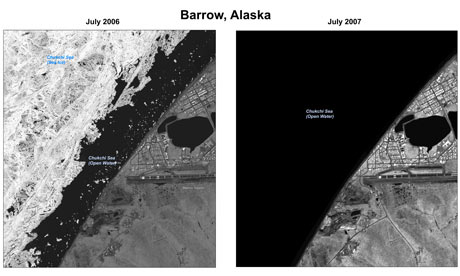
Graphic images that reveal the devastating impact of global warming in the Arctic have been released by the US military. The photographs, taken by spy satellites over the past decade, confirm that in recent years vast areas in high latitudes have lost their ice cover in summer months.
The pictures, kept secret by Washington during the presidency of George W Bush, were declassified by the White House last week. President Barack Obama is currently trying to galvanise Congress and the American public to take action to halt catastrophic climate change caused by rising levels of carbon dioxide in the atmosphere.
One particularly striking set of images - selected from the 1,000 photographs released - includes views of the Alaskan port of Barrow. One, taken in July 2006, shows sea ice still nestling close to the shore. A second image shows that by the following July the coastal waters were entirely ice-free.
The photographs demonstrate starkly how global warming is changing the Arctic. More than a million square kilometres of sea ice - a record loss - were missing in the summer of 2007 compared with the previous year.
Nor has this loss shown any sign of recovery. Ice cover for 2008 was almost as bad as for 2007, and this year levels look equally sparse.
"These are one-metre resolution images, which give you a big picture of the summertime Arctic," said Thorsten Markus of Nasa's Goddard Space Flight Centre. "This is the main reason why we are so thrilled about it. One-metre resolution is the dimension that's been missing."
Disappearing summer sea ice poses considerable dangers, scientists have warned. Ice shelves are used by animals such as polar bears as platforms for hunting seals and other sea creatures. Without them, they could starve. In addition, ice reflects solar radiation. Without that process, the Arctic sea could warm up even more. The phenomenon threatens to set off runaway heating of the planet, say climatologists.
The latest revelations have triggered warnings from scientists that they no longer have the funds to keep a comprehensive track of climate change. Last week the head of the US's National Oceanic and Atmospheric Administration (NOAA), Professor Jane Lubchenco, warned that the gathering of satellite data - crucial to predicting future climate changes - was now at "great risk" because America's ageing satellite fleet was not being replaced.
"Our primary focus is maintaining the continuity of climate observations, and those are at great risk right now because we don't have the resources to have satellites at the ready and taking the kinds of information that we need," said Lubchenco, who was appointed by Obama. "We are playing catch-up."
Even before her warning, scientists were saying that America, the world's scientific superpower, was virtually blinding itself to climate change by cutting funds to the environmental satellite programmes run by the Oceanic and Atmospheric Administration and Nasa. A report by the National Academy of Sciences this year warned that the environmental satellite network was at risk of collapse.
In February, a Nasa satellite carrying instruments to produce the first map of the Earth's carbon emissions crashed near Antarctica only three minutes after lift-off.
The satellite would have measured carbon emissions at 100,000 points around the planet every day, providing a wealth of data compared to the 100 or so fixed towers currently in operation in a land-based network.
The NOAA is under additional pressure to provide environmental data because of the re-emergence of the El Niño climate phenomenon, where warming of the tropical Pacific causes heatwaves, droughts and flooding around the world. June's land and sea surface temperatures were the second hottest on record, and scientists are predicting this will be the warmest decade in recorded history. The last major El Niño was in 1998, the hottest year in recorded history.
The Obama administration has already taken steps to tackle America's flagging scientific lead. The president's economic recovery plan allotted $170m (£100m) to help close the gaps in climate modelling. The NOAA is seeking an additional $390m in its 2010 budget to upgrade environmental satellites, and help make data more available to researchers and government officials.
Sunday, July 26, 2009
Do you like TED
Carole Cadwalladr reports from the coolest conference on Earth that attracts a vast web audience
It's a confusing place, the world of TED. Not just because that for an event which prides itself on its cleverness, it has a name that makes it sound like some sort of football jock, but because, one minute you're listening to a talk about how an artificial brain is just 10 years off completion and the next you're thinking, oh look there's Cameron Diaz. And then, in an unscheduled departure from the timetable, Gordon Brown walks on to the stage.
Even more confusingly, he receives not one standing ovation, but two! They cheer. They applaud. They, actually, whoop. But at TED, I discover, all things are possible - including a belief in an infinite number of parallel universes, in one of which Brown is the most popular man in Britain.
Truly, anything is possible in the universe known as TED. You might see flatscreen TV with no wires, no plug, nothing - one of the first public demonstrations of wireless electricity by Eric Giler. Or a British inventor, Michael Pritchard, turning sewage water into drinking water with a simple plastic bottle which he claims could save two-and-a-half million children's lives a year. Or you could be queuing up to get into the talk on nuclear fusion (coming to a reactor near you by 2030, according to the British physicist Steven Cowley), and Meg Ryan will step on your toe.
Strange and very confusing, then. Because TED isn't named after a US football jock, it actually stands for Technology, Entertainment & Design, which was the meat of its business when it was set up, in California in 1984 - heady days which saw the unveiling of the first Macintosh computer. Now, however, it has a far wider, more implausible remit. It aims to bring together ideas that it hopes might just change the world. It's the kind of rampant hubristic ambition which is all very well in the Golden State, but this is Britain. We do not whoop. We do not holler - although, just possibly, we're starting to learn.
Because TED came to Oxford last week in its new form, TEDGlobal, an event that will be held annually and costs $4,500 (£2,700) just to attend; accommodation is extra. Even then you need to be invited, or put yourself through a rigorous application procedure, including an essay question, and a system of mysterious positive vetting all designed to ensure you are "curious, creative, playful and open-minded".
Which sounds distinctly Orwellian. Or at least Freemasonish. Yet everybody who comes to TED loves TED. Apart from a lone British journalist, although even he admits on the last night that he might quite like it. Even a guerilla operation calling itself Bil - which complains that the "unwashed masses" are kept out through the exorbitant price, loves TED - so much so that it hosted its own fringe event, "an open, self-organising alternative to TED".
Because what TED excels in is amazing ideas, brilliantly presented. And the selection process is all part of what has gone into making it into what has been called "the coolest conference on Earth" and "a Davos of the mind", although it has also been called "a cultish talking shop" - by the Times, last week - a fact which exercises the man who calls himself its "curator", Chris Anderson, and who at various points asks the audience if it's cultish enough for us. It is, actually. Because you do have to be inducted into the TED way of doing things, which someone describes to me as "the conversion process" - all talks are exactly 18 minutes long and there are never any questions from the floor. And it's all so intense - packed bursts of talks and ideas and strange synthy music from the likes of Imogen Heap for 10-12 hours most days. And that's before the parties begin.
In 2005 I attended the TEDGlobal prototype which was fascinating but undeniably elitist. One year later, they put all the talks online and it has become a global phenomenon. More than 300,000 people a day watch a TED talk; a hundred million a year. Since February, the numbers have been doubling. Thousands now watch the entire conference on live-streaming. A brand new translation software has seen 150 volunteers translate 1,000 talks into 150 languages in just a couple of months. Ideas, it seems, are the new rock'n'roll. And TED is its Woodstock.
What it's done, remarkably, is to turn nerdy, unknown academics into worldwide superstars. A Swedish professor of global health called Hans Rosling has become the Susan Boyle of the academic world. "How many people did he reach before?" asks Bruno Giussani, the European director of TED. "Maybe he had 150 students a year? Now he's reaching millions. It's transformed the nature and concept of what it is to be teacher."
Anderson says it has taken them all by surprise. "We weren't sure the intensity of the live experience would translate to a four-inch screen, but it just took off and we realised we shouldn't be thinking of it as a conference any more. It was about ideas spreading. The real audience is online. It's changed everything."
In 2005, I listened to speaker after speaker talk about the Creative Commons and how if you open something up to the masses they perform amazing, unprecedented feats. And, in just four years, it is what has happened to TED.
Three months ago, it launched TEDx, self-organised TED events that use the talks as the basis for a live event, and now it's taken off in 300 cities, from Antananarivo in Madagascar to Kuala Lumpur, and even, later this summer Sheffield, Newcastle, Manchester, Liverpool and Leeds (tedxnorth.com). Anderson, an Englishman who made his fortune as a media entrepreneur, founding Future Publishing which at its peak owned 130 magazines and employed 1,500 people, says that he suspects it's that "something is missing from the media diet. Beyond 'if it bleeds, it leads', and celebrity tittle-tattle, people want to learn new things."
It's true, it's addictive learning new things at TED. There's Garik Israelian, a spectroscopist who explains why he believes that we will find signs of extraterrestrial life within 10 years. Then there's Rebecca Saxe's remarkable talk on the RPTJ region of the brain which, if targeted with a magnetic pulse, can actually change people's moral judgments.
"Don't you have the Pentagon calling?" Anderson asks her.
"I do," she replies. "I just don't take their calls."
Then there are the coffee breaks when you find yourself talking to someone such as Peter Vermeersch, a political science professor from Leuven in Belgium, who got 50 poets to rewrite the EU constitution in verse, Steve Truglia who is planning to parachute from outer space, or Jeff Bezos, the founder of Amazon, or one of the TED Fellows, a group of extraordinary young people from around the world who are sponsored to attend including Frederick Balagadde from Uganda who has invented a micro-fluidic chip which could bring HIV diagnostics down from $65 to $10.
But actually, the celebrity tittle tattle's not bad either. Jonathan from the BBC says he saw a woman walking down the street "and of course I'd have had absolutely no idea who she was except she was wearing a great big name tag on her chest which said: CAMERON DIAZ."
It's no wonder the celebs love it. They are the least interesting people in the audience. I completely fail to spot the fact that I've been sitting next to two supermodels (Petra Nemcova and Karolina Kurkova). And although there's a frisson when Oxford physicist David Deutsch walks into the room, Meg Ryan can hang out in Costa Coffee completely unmolested. There's probably nowhere else on Earth that's quite as levelling as being a celeb at TED. Even in prison, Paris Hilton managed to upgrade to an executive cell; at TED, if you register late you're going to be staying in a college room in Keble even if you're the head of a charitable foundation and married to a multi-billionaire hedge-fund manager, as happened to one woman I chat to.
"I had to carry my suitcase up two flights of stairs!" she says. "I thought I was going to die!"
The competition among speakers is so high that even the British celebs with vaguely intellectual credentials don't cut it at TED. Alain de Botton pulls it off, but Stephen Fry just hasn't prepared. At TED it's not just about what you say, but how you communicate it to the audience, and preparation is key.
"It's too short for an academic to do their standard 45-minute presentation, and too long to improvise. You have to prepare and have to take a fresh approach," says Giussani. "It really puts pressure on them."
And it works. Not just in the room, but out in the big wide world. The very first person I meet at TED, beaming like a very small child who has just been given a very large ice-cream, is a firefighter from Sacramento called David Dolson IV. He wants to set up an international burns camp sharing knowledge about best practice in burn treatment and has watched every single TED talk online.
"My buddy introduced me to them and you watch one and it's a domino effect, you want to watch them all. And so I did. And it just really inspired me to want to do something, you know?"
I do know. Because it's what everybody says all of the time. David paid more than $6,000 to come to TED out of his own pocket - "and we're some of the lowest-paid firefighters in the country" - but he's loving it. So is Maria Popova, a Bulgarian blogger, and a huge TED fan ("Really - they could cut off my left leg and I'd still love it") who raised the money to come via her followers on Twitter in just six days.
James Purnell, who resigned from the cabinet last month turns up on a day-pass on Thursday. He says he has downloaded dozens of the talks on to his iPhone "and I'm probably even going to pay with my own money to come back next year". An MP! Paying for something! It's nothing short of a revolution.
Anderson is always saying that TED is about the exchange of ideas. Ideas Worth Sharing. And if Hollywood stars love TED, then TED returns the favour. The production values are impossibly high. Vast amounts are spent getting it right and the programming shows a Robert McKee-like grasp of plot, triumph over adversity being the Tedster's favourite.
Elaine Morgan, now almost 90, gives a gripping account of her life-long quest to prove that her theory that humans are descended from an aquatic ape. She has been dismissed as a nutcase for years, but both David Attenborough and Daniel Dennett have recently come around. Most movingly of all, however, is Emmanuel Jal, a former child soldier who was smuggled out of Sudan by a British aid worker, Emma McCune, and who is now a rapper. He sings a song called "What would I be if Emma McCune never rescued me?" and it's impossibly emotional. Hardened CEOs break down and weep; a TED lunch half an hour later immediately votes to give him €10,000 (£8,600).
But then there's a Dragon's Den element to TED. The TED Prize, for starters, which awards $100,000 to three people every year to carry out "a wish". And I'm chatting to Giussani, when Pritchard, the water purifying man, rushes up to him.
"Thank you so much, Bruno! There was me saying, no, I've never heard of TED, I haven't got time, well, humble pie all over my face. It's been absolutely amazing."
He had no idea what TED was, he says, "and then I looked online and saw Bill Gates and Bill Clinton and thought, bloody hell. And I practised and I practised and I practised and now I've got major foundations coming up to me and saying they think it's fantastic".
When I speak to Elaine Morgan, she says in a cracked voice: "I've been struggling to get this idea across my entire life, and then to have this reaction! Well, it's amazing."
It is, and it's life-changing not just for Emmanuel Jal, who might finally get the money for the school he wants to build in Sudan, but for those who watch it too. Even Carole Stone, the queen of networkers ("I have 40,000 people in my database"), tells me she has decided to change her life: "I've got to do something! I thought it was enough to put people together. But it's not!"
Then there's Andy Hobsbawm, who was my TED pal in 2005 and shared my delighted non-comprehension of a David Deutsch talk. I went home; he set up a non-profit foundation, Do The Green Thing. "I had a TED epiphany," he says. "I just heard all these speakers talking about climate change and I thought what can I do?"
Jesus, Andy, I say. I've managed to go to the pub a couple of times. But that's ideas for you. You never know where they might land. And at TED they're gushing from the 50 speakers and the 700 audience members, and from there, out on to the internet, and off to everywhere else, landing where they land.
Most viewed
Among Ted's "most favourite" talks:
Ted 2006: Sir Ken Robinson makes a case for creating an education system that nurtures creativity and champions a radical rethink of our school systems.
www.ted.com/talks/ken_robinson_says_schools_kill_creativity.html
Ted 2008: Neuroscientist Jill Bolte Taylor got a research opportunity few would wish for: she had a massive stroke and watched as her brain functions - motion, speech, self-awareness - shut down one by one.
www.ted.com/talks/jill_bolte_taylor_s_powerful_stroke_of_insight.html
Ted 2006: A Swedish professor of global health, Hans Rosling, debunks myths about the "developing world", a talk that culminates in him swallowing a sword.
www.ted.com/talks/hans_rosling_shows_the_best_stats_you_ve_ever_seen.html
A brief history
TED is owned by a non-profit foundation and devoted to "ideas worth spreading". It now includes science, culture and development. At its main conference in California, speakers have included Bill Clinton, Bill Gates, and Google founders Sergey Brin and Larry Page. TedGlobal will be held annually in Oxford, and the talks posted online at ted.com.
What they said in Oxford
• "We're going to build a realistic model of the human brain within the next 10 years ... and if we build it right, it will speak."
Henry Markram, director of the Centre of Neuroscience and Technology in Lausanne, Switzerland
• "Spectroscopy can change this world. In 15 to 20 years we will discover a spectrum like ours and an Earth-like planet."
Garik Israelian, an astronomer at the Instituto de Astrofísica de Canarias
• "Batteries suck! 40 billion disposable batteries are being thrown away each year."
Eric Giler, CEO WiTricity, who demonstrated a TV powered by wireless electricity.
• "Eighty per cent of the global trade in food is controlled by just five corporations."
Carolyn Steel, architect and author of The Hungry City
• "Ipod liberalism" doesn't exist. "There's an assumption that if you give people enough connectivity and enough devices, democracy will inevitably follow. It doesn't."
Evgeny Morozov, fellow of the Open Society Institute, New York, originally from Belarus.
• "The World Health Organization estimates between 150 million and one billion people would see their lives change if they had glasses."
Joshua Silver, professor of physics of Oxford University, and inventor of self-adjusting glasses that require no optometrist.
• "People say, 'I like the theory but I think it's wrong because everyone I talk to says it's wrong and they can't all be wrong.' Well, yes they can!"
Elaine Morgan, author of The Aquatic Ape
• "The next time you see someone driving a Ferrari, don't think they are greedy, think they are vulnerable and in need of love."
Alain de Botton
It's a confusing place, the world of TED. Not just because that for an event which prides itself on its cleverness, it has a name that makes it sound like some sort of football jock, but because, one minute you're listening to a talk about how an artificial brain is just 10 years off completion and the next you're thinking, oh look there's Cameron Diaz. And then, in an unscheduled departure from the timetable, Gordon Brown walks on to the stage.
Even more confusingly, he receives not one standing ovation, but two! They cheer. They applaud. They, actually, whoop. But at TED, I discover, all things are possible - including a belief in an infinite number of parallel universes, in one of which Brown is the most popular man in Britain.
Truly, anything is possible in the universe known as TED. You might see flatscreen TV with no wires, no plug, nothing - one of the first public demonstrations of wireless electricity by Eric Giler. Or a British inventor, Michael Pritchard, turning sewage water into drinking water with a simple plastic bottle which he claims could save two-and-a-half million children's lives a year. Or you could be queuing up to get into the talk on nuclear fusion (coming to a reactor near you by 2030, according to the British physicist Steven Cowley), and Meg Ryan will step on your toe.
Strange and very confusing, then. Because TED isn't named after a US football jock, it actually stands for Technology, Entertainment & Design, which was the meat of its business when it was set up, in California in 1984 - heady days which saw the unveiling of the first Macintosh computer. Now, however, it has a far wider, more implausible remit. It aims to bring together ideas that it hopes might just change the world. It's the kind of rampant hubristic ambition which is all very well in the Golden State, but this is Britain. We do not whoop. We do not holler - although, just possibly, we're starting to learn.
Because TED came to Oxford last week in its new form, TEDGlobal, an event that will be held annually and costs $4,500 (£2,700) just to attend; accommodation is extra. Even then you need to be invited, or put yourself through a rigorous application procedure, including an essay question, and a system of mysterious positive vetting all designed to ensure you are "curious, creative, playful and open-minded".
Which sounds distinctly Orwellian. Or at least Freemasonish. Yet everybody who comes to TED loves TED. Apart from a lone British journalist, although even he admits on the last night that he might quite like it. Even a guerilla operation calling itself Bil - which complains that the "unwashed masses" are kept out through the exorbitant price, loves TED - so much so that it hosted its own fringe event, "an open, self-organising alternative to TED".
Because what TED excels in is amazing ideas, brilliantly presented. And the selection process is all part of what has gone into making it into what has been called "the coolest conference on Earth" and "a Davos of the mind", although it has also been called "a cultish talking shop" - by the Times, last week - a fact which exercises the man who calls himself its "curator", Chris Anderson, and who at various points asks the audience if it's cultish enough for us. It is, actually. Because you do have to be inducted into the TED way of doing things, which someone describes to me as "the conversion process" - all talks are exactly 18 minutes long and there are never any questions from the floor. And it's all so intense - packed bursts of talks and ideas and strange synthy music from the likes of Imogen Heap for 10-12 hours most days. And that's before the parties begin.
In 2005 I attended the TEDGlobal prototype which was fascinating but undeniably elitist. One year later, they put all the talks online and it has become a global phenomenon. More than 300,000 people a day watch a TED talk; a hundred million a year. Since February, the numbers have been doubling. Thousands now watch the entire conference on live-streaming. A brand new translation software has seen 150 volunteers translate 1,000 talks into 150 languages in just a couple of months. Ideas, it seems, are the new rock'n'roll. And TED is its Woodstock.
What it's done, remarkably, is to turn nerdy, unknown academics into worldwide superstars. A Swedish professor of global health called Hans Rosling has become the Susan Boyle of the academic world. "How many people did he reach before?" asks Bruno Giussani, the European director of TED. "Maybe he had 150 students a year? Now he's reaching millions. It's transformed the nature and concept of what it is to be teacher."
Anderson says it has taken them all by surprise. "We weren't sure the intensity of the live experience would translate to a four-inch screen, but it just took off and we realised we shouldn't be thinking of it as a conference any more. It was about ideas spreading. The real audience is online. It's changed everything."
In 2005, I listened to speaker after speaker talk about the Creative Commons and how if you open something up to the masses they perform amazing, unprecedented feats. And, in just four years, it is what has happened to TED.
Three months ago, it launched TEDx, self-organised TED events that use the talks as the basis for a live event, and now it's taken off in 300 cities, from Antananarivo in Madagascar to Kuala Lumpur, and even, later this summer Sheffield, Newcastle, Manchester, Liverpool and Leeds (tedxnorth.com). Anderson, an Englishman who made his fortune as a media entrepreneur, founding Future Publishing which at its peak owned 130 magazines and employed 1,500 people, says that he suspects it's that "something is missing from the media diet. Beyond 'if it bleeds, it leads', and celebrity tittle-tattle, people want to learn new things."
It's true, it's addictive learning new things at TED. There's Garik Israelian, a spectroscopist who explains why he believes that we will find signs of extraterrestrial life within 10 years. Then there's Rebecca Saxe's remarkable talk on the RPTJ region of the brain which, if targeted with a magnetic pulse, can actually change people's moral judgments.
"Don't you have the Pentagon calling?" Anderson asks her.
"I do," she replies. "I just don't take their calls."
Then there are the coffee breaks when you find yourself talking to someone such as Peter Vermeersch, a political science professor from Leuven in Belgium, who got 50 poets to rewrite the EU constitution in verse, Steve Truglia who is planning to parachute from outer space, or Jeff Bezos, the founder of Amazon, or one of the TED Fellows, a group of extraordinary young people from around the world who are sponsored to attend including Frederick Balagadde from Uganda who has invented a micro-fluidic chip which could bring HIV diagnostics down from $65 to $10.
But actually, the celebrity tittle tattle's not bad either. Jonathan from the BBC says he saw a woman walking down the street "and of course I'd have had absolutely no idea who she was except she was wearing a great big name tag on her chest which said: CAMERON DIAZ."
It's no wonder the celebs love it. They are the least interesting people in the audience. I completely fail to spot the fact that I've been sitting next to two supermodels (Petra Nemcova and Karolina Kurkova). And although there's a frisson when Oxford physicist David Deutsch walks into the room, Meg Ryan can hang out in Costa Coffee completely unmolested. There's probably nowhere else on Earth that's quite as levelling as being a celeb at TED. Even in prison, Paris Hilton managed to upgrade to an executive cell; at TED, if you register late you're going to be staying in a college room in Keble even if you're the head of a charitable foundation and married to a multi-billionaire hedge-fund manager, as happened to one woman I chat to.
"I had to carry my suitcase up two flights of stairs!" she says. "I thought I was going to die!"
The competition among speakers is so high that even the British celebs with vaguely intellectual credentials don't cut it at TED. Alain de Botton pulls it off, but Stephen Fry just hasn't prepared. At TED it's not just about what you say, but how you communicate it to the audience, and preparation is key.
"It's too short for an academic to do their standard 45-minute presentation, and too long to improvise. You have to prepare and have to take a fresh approach," says Giussani. "It really puts pressure on them."
And it works. Not just in the room, but out in the big wide world. The very first person I meet at TED, beaming like a very small child who has just been given a very large ice-cream, is a firefighter from Sacramento called David Dolson IV. He wants to set up an international burns camp sharing knowledge about best practice in burn treatment and has watched every single TED talk online.
"My buddy introduced me to them and you watch one and it's a domino effect, you want to watch them all. And so I did. And it just really inspired me to want to do something, you know?"
I do know. Because it's what everybody says all of the time. David paid more than $6,000 to come to TED out of his own pocket - "and we're some of the lowest-paid firefighters in the country" - but he's loving it. So is Maria Popova, a Bulgarian blogger, and a huge TED fan ("Really - they could cut off my left leg and I'd still love it") who raised the money to come via her followers on Twitter in just six days.
James Purnell, who resigned from the cabinet last month turns up on a day-pass on Thursday. He says he has downloaded dozens of the talks on to his iPhone "and I'm probably even going to pay with my own money to come back next year". An MP! Paying for something! It's nothing short of a revolution.
Anderson is always saying that TED is about the exchange of ideas. Ideas Worth Sharing. And if Hollywood stars love TED, then TED returns the favour. The production values are impossibly high. Vast amounts are spent getting it right and the programming shows a Robert McKee-like grasp of plot, triumph over adversity being the Tedster's favourite.
Elaine Morgan, now almost 90, gives a gripping account of her life-long quest to prove that her theory that humans are descended from an aquatic ape. She has been dismissed as a nutcase for years, but both David Attenborough and Daniel Dennett have recently come around. Most movingly of all, however, is Emmanuel Jal, a former child soldier who was smuggled out of Sudan by a British aid worker, Emma McCune, and who is now a rapper. He sings a song called "What would I be if Emma McCune never rescued me?" and it's impossibly emotional. Hardened CEOs break down and weep; a TED lunch half an hour later immediately votes to give him €10,000 (£8,600).
But then there's a Dragon's Den element to TED. The TED Prize, for starters, which awards $100,000 to three people every year to carry out "a wish". And I'm chatting to Giussani, when Pritchard, the water purifying man, rushes up to him.
"Thank you so much, Bruno! There was me saying, no, I've never heard of TED, I haven't got time, well, humble pie all over my face. It's been absolutely amazing."
He had no idea what TED was, he says, "and then I looked online and saw Bill Gates and Bill Clinton and thought, bloody hell. And I practised and I practised and I practised and now I've got major foundations coming up to me and saying they think it's fantastic".
When I speak to Elaine Morgan, she says in a cracked voice: "I've been struggling to get this idea across my entire life, and then to have this reaction! Well, it's amazing."
It is, and it's life-changing not just for Emmanuel Jal, who might finally get the money for the school he wants to build in Sudan, but for those who watch it too. Even Carole Stone, the queen of networkers ("I have 40,000 people in my database"), tells me she has decided to change her life: "I've got to do something! I thought it was enough to put people together. But it's not!"
Then there's Andy Hobsbawm, who was my TED pal in 2005 and shared my delighted non-comprehension of a David Deutsch talk. I went home; he set up a non-profit foundation, Do The Green Thing. "I had a TED epiphany," he says. "I just heard all these speakers talking about climate change and I thought what can I do?"
Jesus, Andy, I say. I've managed to go to the pub a couple of times. But that's ideas for you. You never know where they might land. And at TED they're gushing from the 50 speakers and the 700 audience members, and from there, out on to the internet, and off to everywhere else, landing where they land.
Most viewed
Among Ted's "most favourite" talks:
Ted 2006: Sir Ken Robinson makes a case for creating an education system that nurtures creativity and champions a radical rethink of our school systems.
www.ted.com/talks/ken_robinson_says_schools_kill_creativity.html
Ted 2008: Neuroscientist Jill Bolte Taylor got a research opportunity few would wish for: she had a massive stroke and watched as her brain functions - motion, speech, self-awareness - shut down one by one.
www.ted.com/talks/jill_bolte_taylor_s_powerful_stroke_of_insight.html
Ted 2006: A Swedish professor of global health, Hans Rosling, debunks myths about the "developing world", a talk that culminates in him swallowing a sword.
www.ted.com/talks/hans_rosling_shows_the_best_stats_you_ve_ever_seen.html
A brief history
TED is owned by a non-profit foundation and devoted to "ideas worth spreading". It now includes science, culture and development. At its main conference in California, speakers have included Bill Clinton, Bill Gates, and Google founders Sergey Brin and Larry Page. TedGlobal will be held annually in Oxford, and the talks posted online at ted.com.
What they said in Oxford
• "We're going to build a realistic model of the human brain within the next 10 years ... and if we build it right, it will speak."
Henry Markram, director of the Centre of Neuroscience and Technology in Lausanne, Switzerland
• "Spectroscopy can change this world. In 15 to 20 years we will discover a spectrum like ours and an Earth-like planet."
Garik Israelian, an astronomer at the Instituto de Astrofísica de Canarias
• "Batteries suck! 40 billion disposable batteries are being thrown away each year."
Eric Giler, CEO WiTricity, who demonstrated a TV powered by wireless electricity.
• "Eighty per cent of the global trade in food is controlled by just five corporations."
Carolyn Steel, architect and author of The Hungry City
• "Ipod liberalism" doesn't exist. "There's an assumption that if you give people enough connectivity and enough devices, democracy will inevitably follow. It doesn't."
Evgeny Morozov, fellow of the Open Society Institute, New York, originally from Belarus.
• "The World Health Organization estimates between 150 million and one billion people would see their lives change if they had glasses."
Joshua Silver, professor of physics of Oxford University, and inventor of self-adjusting glasses that require no optometrist.
• "People say, 'I like the theory but I think it's wrong because everyone I talk to says it's wrong and they can't all be wrong.' Well, yes they can!"
Elaine Morgan, author of The Aquatic Ape
• "The next time you see someone driving a Ferrari, don't think they are greedy, think they are vulnerable and in need of love."
Alain de Botton
Wednesday, July 22, 2009
My microbes made me do it...
This week, the 40th anniversary of the first moon landing, there’s much talk of exploring other worlds. Which is exciting and grand; such is the stuff that dreams are made on. Yet we don’t need to go abroad to find amazing new life forms. We just need to look at the palms of our hands, the tips of our fingers, the contents of our guts.
The typical human is home to a vast array of microbes. If you were to count them, you’d find that microbial cells outnumber your own by a factor of 10. On a cell-by-cell basis, then, you are only 10 percent human. For the rest, you are microbial. (Why don’t you see this when you look in the mirror? Because most of the microbes are bacteria, and bacterial cells are generally much smaller than animal cells. They may make up 90 percent of the cells, but they’re not 90 percent of your bulk.)
This much has been known for a long time. Yet it’s only now, with the revolution in biotechnology, that we’re able to do detailed studies of which microbes are there, which genes they have, and what they’re doing. We’re just at the start, and there are far more questions than answers. But already, the results are astonishing, and the implications profound.
Even on your skin, the diversity of bacteria is prodigious. If you were to have your hands sampled, you’d probably find that each fingertip has a distinct set of residents; your palms probably also differ markedly from each other, each home to more than 150 species, but with fewer than 20 percent of the species the same. And if you’re a woman, odds are you’ll have more species than the man next to you. Why should this be? So far, no one knows.
But it’s the bacteria in the digestive tract, especially the gut, that intrigue me most. Many of these appear to be true symbionts: they have evolved to live in guts and (as far as we know) are not found elsewhere. In providing their habitat — a constant temperature, some protection from hostile lifeforms and regular influxes of food — we are as essential to them as they are to us.
And they definitely are essential to us. Gut bacteria play crucial roles in digesting food and modulating the immune system. They make small molecules that we need in order for our enzymes to work properly. They interact with us, altering which of our genes get turned on and off in cells in the intestinal walls. Some evidence suggests that they are essential for the building of a normal heart. Finally, it seems likely that gut bacteria will turn out to affect appetite, as well as other aspects of our behavior, though no one has shown this yet. (Imagine the plea: I’m sorry, sir, my microbes made me do it.)
Together, your gut microbes provide you with a pool of genes far larger than that found in the human genome. Indeed, the gut “microbiome,” as it is known, is thought to contain at least 100 times more genes than the human genome. Moreover, whereas humans are extremely similar to one another at the level of the genome, the microbiome appears to differ markedly from one person to the next.
What determines these differences? Good question. Diet has some effect: a diet rich in sugars and fats reduces the diversity of gut bacteria, and shifts the balance towards those that are more efficient at extracting energy. Start eating more plants and you can shift the balance back, and increase the diversity of your gut microbes. Your own genetic background may play a role as well, though we are far from understanding how, or how much. It probably also matters which other microbes are present: as in any ecosystem, relationships among different inhabitants are likely to be complex.
(At this point, I’d like to introduce a caveat. We know that the diversity of microbial species differs between your gut and mine, and that the less related we are, the more that will be true. Family members tend to have more similar gut microbes than nonrelatives, and preliminary evidence suggests that geography matters, too. So the gut microbes of people in China are different from those of people in the United States — though whether this is due to diet, human genes or geography is entirely unknown. But despite this variation at the species level, we don’t yet know how much variation there is at the genetic level. It may be that different sets of gut microbes provide broadly equivalent sets of genes.)
Naturally, a huge effort is now under way to see whether differences in gut bacteria are responsible for differences in health. But what interests me most about all this is that it suggests another mode of human evolution. Bacteria evolve quickly: they can go through many thousands of generations for every human one.
This has two potential consequences. First, during your lifetime, your bacteria can change their genes even though you cannot change yours. (You do have some flexibility: your immune system has a built-in capacity to change.) It may be that gut bacteria evolve in response to short-term changes in the environment, especially exposure to food-borne diseases. They may thus act as an evolving supplement to the immune system.
The second potential consequence is further reaching. Because bacteria can evolve so fast, it may be that some of what we think of as human evolution — like the ability to digest new diets that accompanied the invention of agriculture — is actually bacterial evolution. We know that hostile bacteria — those that cause diseases in ourselves and our domestic plants and animals — have undergone dramatic genetic changes in the last 10,000 years. Perhaps our friendly bacteria have, too.
Notes:
For human cells being outnumbered by microbial cells by a factor of 10, see Savage, D. C. 1977. “Microbial ecology of the gastrointestinal tract.” Annual Review of Microbiology 31: 107-133. For new techniques in analyzing microbes that we cannot grow in the laboratory see, for example, Marcy, Y. et al. 2007. “Dissecting biological ‘dark matter’ with single-cell genetic analysis of rare and uncultivated TM7 microbes from the human mouth.” Proceedings of the National Academy of Sciences USA 104: 11889-11894.
For bacteria living on hands, see Fierer, N. et al. 2008. “The influence of sex, handedness, and washing on the diversity of hand surface bacteria.” Proceedings of the National Academy of Sciences USA 105: 17994-17999. For gut microbes not being found elsewhere, see Ley, R. E. et al. 2008. “Worlds within worlds: evolution of the vertebrate gut microbiota.” Nature Reviews Microbiology 6: 776-788.
For a summary of the essential roles that gut microbes play, see Turnbaugh, P. J. et al. 2007. “The human microbiome project.” Nature 449: 804-810. For estimates of the number of genes contained in the microbiome, see Gill, S. R. et al. 2006. “Metagenomic analysis of the human distal gut microbiome.” Science 312: 1355-1359.
For diet affecting human microbial diversity, see Ley, R. E. et al. 2006. “Human gut microbes associated with obesity.” Nature 444: 1022-1023. For “obese” microbes harvesting more energy, see Turnbaugh, P. J. et al. 2006. “An obesity-associated gut microbiome with increased capacity for energy harvest.” Nature 444: 1027-1031. For initial evidence that the genetic background of the host affects which microbes are present, see Rawls, J. F. et al. 2006. “Reciprocal gut microbiota transplants from zebrafish and mice to germ-free recipients reveal host habitat selection.” Cell 127: 423-433.
For differences in gut microbes between people in China and the United States, see Li, M. et al. 2008. “Symbiotic gut microbes modulate human metabolic phenotypes.” Proceedings of the National Academy of Sciences USA 105: 2117-2123. For evidence that different sets of gut microbes can provide broadly equivalent sets of genes, see Turnbaugh, P. J. et al. 2009. “A core gut microbiome in obese and lean twins.” Nature 457: 480-484.
For recent and dramatic genetic changes to our hostile bacteria, see Mira, A., Rushker, R. and Rodriguez-Valera F. 2006. “The Neolithic revolution of bacterial genomes.” Trends in Microbiology 14: 200-206.
Many thanks to Rob Knight and Jonathan Swire for insights, comments and suggestions.
The typical human is home to a vast array of microbes. If you were to count them, you’d find that microbial cells outnumber your own by a factor of 10. On a cell-by-cell basis, then, you are only 10 percent human. For the rest, you are microbial. (Why don’t you see this when you look in the mirror? Because most of the microbes are bacteria, and bacterial cells are generally much smaller than animal cells. They may make up 90 percent of the cells, but they’re not 90 percent of your bulk.)
This much has been known for a long time. Yet it’s only now, with the revolution in biotechnology, that we’re able to do detailed studies of which microbes are there, which genes they have, and what they’re doing. We’re just at the start, and there are far more questions than answers. But already, the results are astonishing, and the implications profound.
Even on your skin, the diversity of bacteria is prodigious. If you were to have your hands sampled, you’d probably find that each fingertip has a distinct set of residents; your palms probably also differ markedly from each other, each home to more than 150 species, but with fewer than 20 percent of the species the same. And if you’re a woman, odds are you’ll have more species than the man next to you. Why should this be? So far, no one knows.
But it’s the bacteria in the digestive tract, especially the gut, that intrigue me most. Many of these appear to be true symbionts: they have evolved to live in guts and (as far as we know) are not found elsewhere. In providing their habitat — a constant temperature, some protection from hostile lifeforms and regular influxes of food — we are as essential to them as they are to us.
And they definitely are essential to us. Gut bacteria play crucial roles in digesting food and modulating the immune system. They make small molecules that we need in order for our enzymes to work properly. They interact with us, altering which of our genes get turned on and off in cells in the intestinal walls. Some evidence suggests that they are essential for the building of a normal heart. Finally, it seems likely that gut bacteria will turn out to affect appetite, as well as other aspects of our behavior, though no one has shown this yet. (Imagine the plea: I’m sorry, sir, my microbes made me do it.)
Together, your gut microbes provide you with a pool of genes far larger than that found in the human genome. Indeed, the gut “microbiome,” as it is known, is thought to contain at least 100 times more genes than the human genome. Moreover, whereas humans are extremely similar to one another at the level of the genome, the microbiome appears to differ markedly from one person to the next.
What determines these differences? Good question. Diet has some effect: a diet rich in sugars and fats reduces the diversity of gut bacteria, and shifts the balance towards those that are more efficient at extracting energy. Start eating more plants and you can shift the balance back, and increase the diversity of your gut microbes. Your own genetic background may play a role as well, though we are far from understanding how, or how much. It probably also matters which other microbes are present: as in any ecosystem, relationships among different inhabitants are likely to be complex.
(At this point, I’d like to introduce a caveat. We know that the diversity of microbial species differs between your gut and mine, and that the less related we are, the more that will be true. Family members tend to have more similar gut microbes than nonrelatives, and preliminary evidence suggests that geography matters, too. So the gut microbes of people in China are different from those of people in the United States — though whether this is due to diet, human genes or geography is entirely unknown. But despite this variation at the species level, we don’t yet know how much variation there is at the genetic level. It may be that different sets of gut microbes provide broadly equivalent sets of genes.)
Naturally, a huge effort is now under way to see whether differences in gut bacteria are responsible for differences in health. But what interests me most about all this is that it suggests another mode of human evolution. Bacteria evolve quickly: they can go through many thousands of generations for every human one.
This has two potential consequences. First, during your lifetime, your bacteria can change their genes even though you cannot change yours. (You do have some flexibility: your immune system has a built-in capacity to change.) It may be that gut bacteria evolve in response to short-term changes in the environment, especially exposure to food-borne diseases. They may thus act as an evolving supplement to the immune system.
The second potential consequence is further reaching. Because bacteria can evolve so fast, it may be that some of what we think of as human evolution — like the ability to digest new diets that accompanied the invention of agriculture — is actually bacterial evolution. We know that hostile bacteria — those that cause diseases in ourselves and our domestic plants and animals — have undergone dramatic genetic changes in the last 10,000 years. Perhaps our friendly bacteria have, too.
Notes:
For human cells being outnumbered by microbial cells by a factor of 10, see Savage, D. C. 1977. “Microbial ecology of the gastrointestinal tract.” Annual Review of Microbiology 31: 107-133. For new techniques in analyzing microbes that we cannot grow in the laboratory see, for example, Marcy, Y. et al. 2007. “Dissecting biological ‘dark matter’ with single-cell genetic analysis of rare and uncultivated TM7 microbes from the human mouth.” Proceedings of the National Academy of Sciences USA 104: 11889-11894.
For bacteria living on hands, see Fierer, N. et al. 2008. “The influence of sex, handedness, and washing on the diversity of hand surface bacteria.” Proceedings of the National Academy of Sciences USA 105: 17994-17999. For gut microbes not being found elsewhere, see Ley, R. E. et al. 2008. “Worlds within worlds: evolution of the vertebrate gut microbiota.” Nature Reviews Microbiology 6: 776-788.
For a summary of the essential roles that gut microbes play, see Turnbaugh, P. J. et al. 2007. “The human microbiome project.” Nature 449: 804-810. For estimates of the number of genes contained in the microbiome, see Gill, S. R. et al. 2006. “Metagenomic analysis of the human distal gut microbiome.” Science 312: 1355-1359.
For diet affecting human microbial diversity, see Ley, R. E. et al. 2006. “Human gut microbes associated with obesity.” Nature 444: 1022-1023. For “obese” microbes harvesting more energy, see Turnbaugh, P. J. et al. 2006. “An obesity-associated gut microbiome with increased capacity for energy harvest.” Nature 444: 1027-1031. For initial evidence that the genetic background of the host affects which microbes are present, see Rawls, J. F. et al. 2006. “Reciprocal gut microbiota transplants from zebrafish and mice to germ-free recipients reveal host habitat selection.” Cell 127: 423-433.
For differences in gut microbes between people in China and the United States, see Li, M. et al. 2008. “Symbiotic gut microbes modulate human metabolic phenotypes.” Proceedings of the National Academy of Sciences USA 105: 2117-2123. For evidence that different sets of gut microbes can provide broadly equivalent sets of genes, see Turnbaugh, P. J. et al. 2009. “A core gut microbiome in obese and lean twins.” Nature 457: 480-484.
For recent and dramatic genetic changes to our hostile bacteria, see Mira, A., Rushker, R. and Rodriguez-Valera F. 2006. “The Neolithic revolution of bacterial genomes.” Trends in Microbiology 14: 200-206.
Many thanks to Rob Knight and Jonathan Swire for insights, comments and suggestions.
Monday, July 20, 2009
Save the planet and your wallet ~ End Energy Obesity
If you are burning a conventional light globe you are using about 1% of the energy produced to do it to product light...get a few LED's a battery and a solar panel and you have saved on the $2000 deposit on a brand new nuclear kilowatt and you can recycle the oil gridware...a smart grid driven energy complexity inversion will change the topology.
Is it any wonder that our energy needs are so great? Nearly everything that defines our way of life requires energy-consuming devices, from cars, planes, trains, and air conditioning to lights and computers. And our global appetite for energy keeps growing as population and wealth obliges consumption on an unfathomable scale.
Over the years, we've made our devices more efficient, only to find, ironically, that it's made us consume even more energy. We've periodically cut back our energy use only to revert back to bad habits. We've added more renewables only to find that fossil fuels still dominate. Now we are energy obese. How can the world reduce its energy appetite and change its diet of fuels for a prosperous and secure tomorrow?
In The End of Energy Obesity, energy expert and bestselling author Peter Tertzakian explores solutions to this question by analyzing the role of technology and circumstance on our energy use. Throughout the book, Tertzakian focuses on the most practical options that provide the highest leverage for resolving our energy problems and reveals how evolving habits, lifestyles, mind-sets, and innovations--that might seem improbable now--will help curb our insatiable energy appetite.
Peter Tertzakian is Chief Energy Economist of ARC Financial Corporation and bestselling author of A Thousand Barrels a Second: The Coming Oil Break Point and the Challenges Facing an Energy Dependent World. Passionate about the history and direction of energy in society, Tertzakian blends three decades of experience in geophysics, economics, technology, and finance to analyze energy trends.
listen
Is it any wonder that our energy needs are so great? Nearly everything that defines our way of life requires energy-consuming devices, from cars, planes, trains, and air conditioning to lights and computers. And our global appetite for energy keeps growing as population and wealth obliges consumption on an unfathomable scale.
Over the years, we've made our devices more efficient, only to find, ironically, that it's made us consume even more energy. We've periodically cut back our energy use only to revert back to bad habits. We've added more renewables only to find that fossil fuels still dominate. Now we are energy obese. How can the world reduce its energy appetite and change its diet of fuels for a prosperous and secure tomorrow?
In The End of Energy Obesity, energy expert and bestselling author Peter Tertzakian explores solutions to this question by analyzing the role of technology and circumstance on our energy use. Throughout the book, Tertzakian focuses on the most practical options that provide the highest leverage for resolving our energy problems and reveals how evolving habits, lifestyles, mind-sets, and innovations--that might seem improbable now--will help curb our insatiable energy appetite.
Peter Tertzakian is Chief Energy Economist of ARC Financial Corporation and bestselling author of A Thousand Barrels a Second: The Coming Oil Break Point and the Challenges Facing an Energy Dependent World. Passionate about the history and direction of energy in society, Tertzakian blends three decades of experience in geophysics, economics, technology, and finance to analyze energy trends.
listen
Want to visit a space ship ~ Try the Mall
I loved this book.... Why does the american right hate NASA? Because its chock full of Global warming beleiving evolutionist liberals who like science, why else.
Review: Exploration: Rocket Dreams by Marina Benjamin
Why the final frontier has never lost its spectacular appeal
LYNNE TRUSS
Recommend?
ROCKET DREAMS How the Space Age Shaped our Vision of a World Beyond by Marina Benjamin (Chatto £12.99 pp277)
Although Marina Benjamin does not specifically mention that red-letter year 2001, what a swizz it turned out to be, really. Some of us will never recover from the let-down; will never quite forgive Stanley Kubrick and Arthur C Clarke for raising too high a level of expectation about mankind’s unstoppable expansion into space. Were we fools to think that, 30 years after the Apollo landings, Pan-Am would be flying routinely to the moon? Three decades seemed more than enough time to get that one sorted. I always wanted to be one of those space-shuttle flight attendants in the powder-blue jumpsuits and the funny marshmallow-shaped hats. I would have volunteered to sew Velcro on the soles of my soft white flatties, and everything.
But if the bathos of 2001 is not one of the actual subjects of Rocket Dreams, Benjamin draws on an identical sense of bewildered disappointment. She remembers that something very strange happened in the 1960s and early 1970s. To simplify: one minute we were living in the space age, the next it was all over. One minute we were aspiring astronauts, practising our conversational Venusian, the next we were pathetically content to get broadband. What happened? Why didn’t we keep boldly going into space? What became of those ideas of living in colonies? How does mankind cope with the terrible sense of failure; of slipping off the ladder of cosmic enlightenment after climbing just one rung?
Well, these questions turn out to require a clever and thoughtful book — a book that is as much concerned with the limits of human imagination as anything. While Benjamin is good on the science and technology (and economics) of the space programme, she returns again and again to the tension in humankind between the urge to explore and the urge to gaze in a mirror. For example: what are the most memorable images from the first moon shots? Pictures of the earth, of course, as an opalescent marble suspended in the void. When those astronauts gazed down at the blue planet, their hearts swelled like Dorothy’s coming back to Kansas. When they described the grim, cat-litter surface of the moon, by contrast, they said things like, “It’s all beat up. No definition. Just lots of bumps and holes.”
The sad fact is that, in terms of real space travel, we got as far as the garden gate and that was it. But what Benjamin interestingly argues in Rocket Dreams is that our Buzz Lightyear impulse (“To infinity, and beyond!”) has not been extinguished; it has simply been channelled into other outlets that arguably suit our true ambivalence better. If you reflect how dreams of the space age (which were all, let’s face it, less about exploration than about colonising) have left us with a capsule mentality, the phenomenon of the shopping mall is explained. No, really. It is a mundane version of a space station. Survivors of the space age want environments that are safe, self-contained and remote from anyone who disagrees with us. Which is why virtual chat-rooms, too, are such a phenomenal success.
As you can see, this is a book rich in ideas, with a scope that at times seems scarily infinite. Personally, I prefer the early chapters on the actual space race, the Ufology movement, and the colony instinct. And I admire the way that Benjamin refuses to foreground popular culture, so that she really does write about the Roswell Incident in 1947 rather than about Steven Spielberg or The X-Files. She did lose me, I admit, in the last sections of the book, which are about staying at home and contacting outer space through one’s computer, where she adopts an evangelical tone and assumes too much technical interest. She makes an important point in passing, though: that digital broadcasting will mean a radio black-out from earth, after all these years sending waves and waves of it into space. Bad news for the aliens who were looking forward to the Hancock repeats on BBC7.
To be honest, Rocket Dreams is a book that leaves you rather jelly-legged — as if you were watching an Imax movie through the wrong end of a telescope. One is left with a vertiginous sense of the earth as this speck in the universe, and an understanding of what this knowledge has done to the human psyche — mainly, made it curl up in a foetal position and watch cartoons. The popularising scientist Carl Sagan is often invoked in these pages: he was a man who loved to pick up a grain of sand on a beach and make humbling comparisons with it. His idea was that, “if we let the universe fill us with awe, we would be both aggrandised by it and, at the same time, calmly reconciled to our limitations”. But he may have been wrong. The size of space may have just scared and belittled us and sent us scuttling into virtual worlds where we have the illusion of control.
How much of this is me, incidentally, and how much is Benjamin is jolly hard to say. This is the sort of book that catches you in its tracking-beam, transports you heavenwards, packs a load of sophisticated data into your primitive brain, and deposits you on a lonely road in Arizona. No wonder I’m not feeling very well. At one point, discussing the mental world of UFO freaks, Benjamin describes their backwards, conspiracy-theory logic as “affirming the consequent” (nice to know there’s a name for it). But the world of this book is topsy-turvy, too: with proofs and theories intermingled, conclusions and premises juggled in a dazzling kind of way. It’s all very stimulating. The truth is out there, definitely. But mainly I just remember this bright light in the sky.
Review: Exploration: Rocket Dreams by Marina Benjamin
Why the final frontier has never lost its spectacular appeal
LYNNE TRUSS
Recommend?
ROCKET DREAMS How the Space Age Shaped our Vision of a World Beyond by Marina Benjamin (Chatto £12.99 pp277)
Although Marina Benjamin does not specifically mention that red-letter year 2001, what a swizz it turned out to be, really. Some of us will never recover from the let-down; will never quite forgive Stanley Kubrick and Arthur C Clarke for raising too high a level of expectation about mankind’s unstoppable expansion into space. Were we fools to think that, 30 years after the Apollo landings, Pan-Am would be flying routinely to the moon? Three decades seemed more than enough time to get that one sorted. I always wanted to be one of those space-shuttle flight attendants in the powder-blue jumpsuits and the funny marshmallow-shaped hats. I would have volunteered to sew Velcro on the soles of my soft white flatties, and everything.
But if the bathos of 2001 is not one of the actual subjects of Rocket Dreams, Benjamin draws on an identical sense of bewildered disappointment. She remembers that something very strange happened in the 1960s and early 1970s. To simplify: one minute we were living in the space age, the next it was all over. One minute we were aspiring astronauts, practising our conversational Venusian, the next we were pathetically content to get broadband. What happened? Why didn’t we keep boldly going into space? What became of those ideas of living in colonies? How does mankind cope with the terrible sense of failure; of slipping off the ladder of cosmic enlightenment after climbing just one rung?
Well, these questions turn out to require a clever and thoughtful book — a book that is as much concerned with the limits of human imagination as anything. While Benjamin is good on the science and technology (and economics) of the space programme, she returns again and again to the tension in humankind between the urge to explore and the urge to gaze in a mirror. For example: what are the most memorable images from the first moon shots? Pictures of the earth, of course, as an opalescent marble suspended in the void. When those astronauts gazed down at the blue planet, their hearts swelled like Dorothy’s coming back to Kansas. When they described the grim, cat-litter surface of the moon, by contrast, they said things like, “It’s all beat up. No definition. Just lots of bumps and holes.”
The sad fact is that, in terms of real space travel, we got as far as the garden gate and that was it. But what Benjamin interestingly argues in Rocket Dreams is that our Buzz Lightyear impulse (“To infinity, and beyond!”) has not been extinguished; it has simply been channelled into other outlets that arguably suit our true ambivalence better. If you reflect how dreams of the space age (which were all, let’s face it, less about exploration than about colonising) have left us with a capsule mentality, the phenomenon of the shopping mall is explained. No, really. It is a mundane version of a space station. Survivors of the space age want environments that are safe, self-contained and remote from anyone who disagrees with us. Which is why virtual chat-rooms, too, are such a phenomenal success.
As you can see, this is a book rich in ideas, with a scope that at times seems scarily infinite. Personally, I prefer the early chapters on the actual space race, the Ufology movement, and the colony instinct. And I admire the way that Benjamin refuses to foreground popular culture, so that she really does write about the Roswell Incident in 1947 rather than about Steven Spielberg or The X-Files. She did lose me, I admit, in the last sections of the book, which are about staying at home and contacting outer space through one’s computer, where she adopts an evangelical tone and assumes too much technical interest. She makes an important point in passing, though: that digital broadcasting will mean a radio black-out from earth, after all these years sending waves and waves of it into space. Bad news for the aliens who were looking forward to the Hancock repeats on BBC7.
To be honest, Rocket Dreams is a book that leaves you rather jelly-legged — as if you were watching an Imax movie through the wrong end of a telescope. One is left with a vertiginous sense of the earth as this speck in the universe, and an understanding of what this knowledge has done to the human psyche — mainly, made it curl up in a foetal position and watch cartoons. The popularising scientist Carl Sagan is often invoked in these pages: he was a man who loved to pick up a grain of sand on a beach and make humbling comparisons with it. His idea was that, “if we let the universe fill us with awe, we would be both aggrandised by it and, at the same time, calmly reconciled to our limitations”. But he may have been wrong. The size of space may have just scared and belittled us and sent us scuttling into virtual worlds where we have the illusion of control.
How much of this is me, incidentally, and how much is Benjamin is jolly hard to say. This is the sort of book that catches you in its tracking-beam, transports you heavenwards, packs a load of sophisticated data into your primitive brain, and deposits you on a lonely road in Arizona. No wonder I’m not feeling very well. At one point, discussing the mental world of UFO freaks, Benjamin describes their backwards, conspiracy-theory logic as “affirming the consequent” (nice to know there’s a name for it). But the world of this book is topsy-turvy, too: with proofs and theories intermingled, conclusions and premises juggled in a dazzling kind of way. It’s all very stimulating. The truth is out there, definitely. But mainly I just remember this bright light in the sky.
Subscribe to:
Posts (Atom)
